Quick answer
Improve GCSE Physics by locking board and tier, then cycling past papers → mark schemes → targeted equation and practical gaps — not by highlighting notes. Nexus Academy runs that loop one-to-one from £14/hr after a free diagnostic, matched to AQA, Pearson Edexcel or OCR.
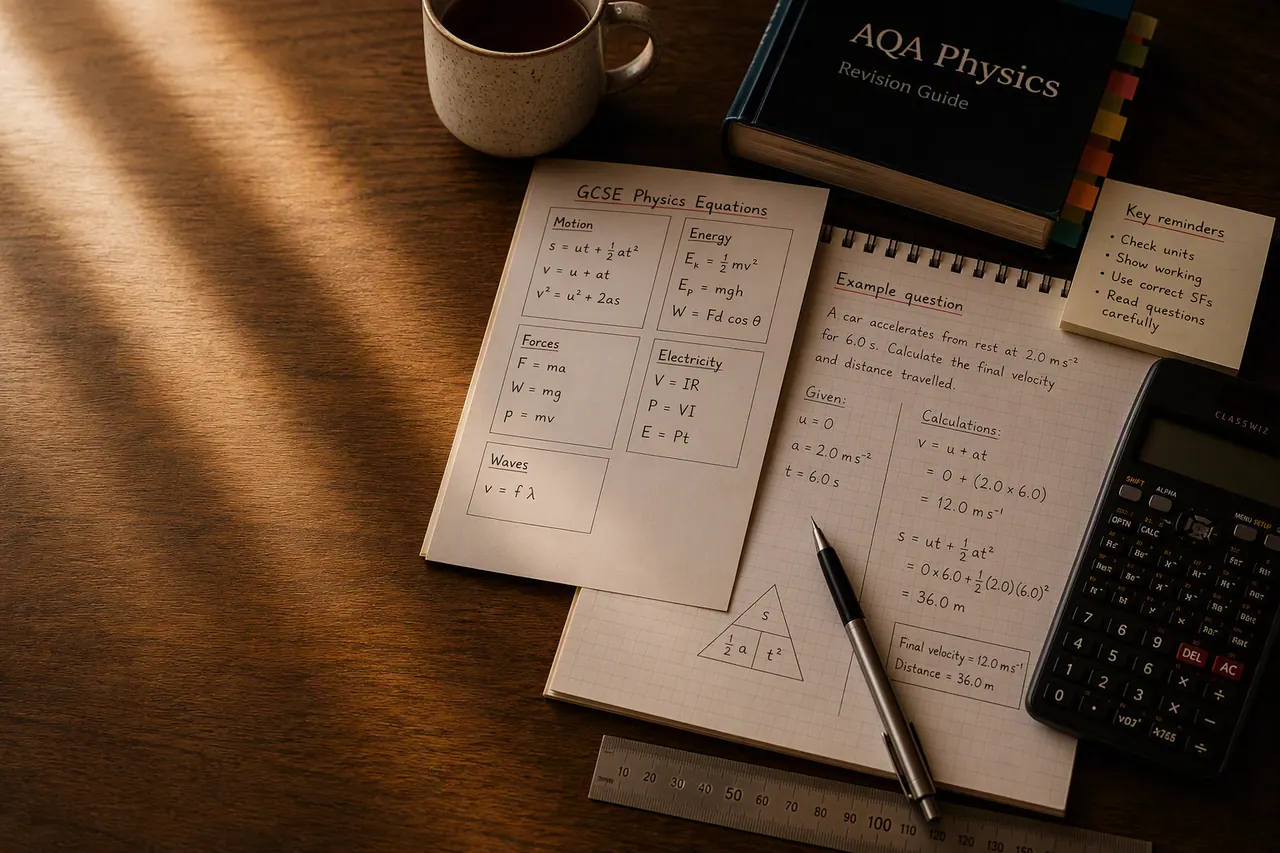
Physics grades improve when students stop treating the subject as a memory dump and start treating it as applied problem-solving: choose the right relationship, rearrange, use units, and explain a practical in exam language. Parents often see the same pattern as Maths — the child “knows the topic” but cannot land method marks under time.
For subject tutoring, go to GCSE Physics tutoring. For equation fluency specifically, use GCSE Physics equations. For practical exam questions across Biology, Chemistry and Physics, see GCSE Science required practicals.
1. Know the specification, route and paper structure
Confirm whether your child is on Triple Physics or Combined Science Physics, Foundation or Higher, and which board the school entered. Content overlap is large; paper length, topic weighting and equation-sheet rules are not identical.
| Check | Why it matters | Parent action |
|---|---|---|
| Board | Question style and data sheet differ (AQA / Edexcel / OCR) | Ask the teacher for the exact code |
| Combined vs Triple | Triple adds depth; Combined shares marks with Bio/Chem | Revise the route they will sit — not both vaguely |
| Tier | Foundation caps lower; Higher assumes stronger Maths | Do not mix Foundation past papers with Higher targets |
2. Past papers with mark schemes — not unmarked worksheets
Sit a recent paper (or timed sections if stamina is low). Mark against the official scheme. Write a short list of leaks: equation choice, rearrangement, graph skills, practical method, or “explain” language. That list becomes the weekly plan. Generic topic videos without a marked paper keep families busy without moving the grade.
Command words still matter: calculate, explain, evaluate, suggest. Students who dump every fact they remember often miss the mark that only needed a named variable or a unit.
3. Equations: select, rearrange, units
Selection. Know which equation fits the quantities in the question before touching the calculator.
Rearrangement. Change the subject on paper. Physics papers reward method marks the same way Maths does.
Units. Convert prefixes (mA, kΩ, cm) before substituting. Unit errors are high-frequency, low-glamour mark loss.
Depth on this sits in the GCSE Physics equations guide. Nexus Academy drills rearrangements until they are automatic — the same fluency problem that hits Year 12 Maths later.
4. Required practicals as exam questions
| Exam ask | What to practise |
|---|---|
| Method / apparatus | Ordered steps; named measuring instruments |
| Variables | Independent, dependent, control — in plain language |
| Graphs & data | Axes, line of best fit, anomalous points |
| Evaluation | Resolution, repeats, systematic vs random error (as your board phrases it) |
Cross-science detail: GCSE Science required practicals. Lab time at school helps; exam marks still need written answers under timed conditions.
5. When tutoring helps — and how Nexus Academy runs it
Tutoring helps when the leak list is stable: same equation family, same practical question type, or Combined content gaps that class pace will not revisit. It does not help if sessions become homework completion with no mark-scheme review.
Nexus Academy starts with a free diagnostic: board, route, recent paper section, then a weekly plan from £14/hr with no lock-in. Book via /book/ or go straight to GCSE Physics tutoring.
Frequently asked questions
How can I improve my GCSE Physics grade?
Nexus Academy improves GCSE Physics by confirming board and tier, then using past papers with mark schemes to find equation, practical and multi-step gaps — not by rereading the whole textbook. Weekly one-to-one sessions from £14/hr follow that diagnosis after a free first lesson.
Do I need to memorise every Physics equation?
Nexus Academy drills which relationships your board expects from memory versus the equation sheet, plus rearrangement under time pressure. See our Physics equations guide for the parent overview against the live specification.
How important are required practicals for the exam?
Nexus Academy revises required practicals as exam questions on method, variables, graphs and evaluation — not as separate coursework in current GCSE routes. Our required practicals guide covers the cluster view across the sciences.
When should we book a GCSE Physics tutor?
Nexus Academy recommends booking when the same equation or practical question type fails on two or three papers, or when Combined/Triple gaps are blocking progress. Free diagnostic, then board-matched Physics tutoring from £14/hr with no lock-in.