GCSE Physics
GCSE Physics Tutor Online — Equations from £14/hr
Looking for a GCSE Physics tutor online? Nexus Academy matches your child with a UK-qualified Physics specialist for AQA, Edexcel or OCR — one-to-one from £14 per hour, with a free demo lesson and no lock-in.
From £14/hr · AQA, Edexcel & OCR · Free first session
Quick answer
Nexus Academy offers a GCSE Physics tutor online from £14 per hour for AQA, Edexcel and OCR, with a free demo lesson and no lock-in.
Why Nexus Academy
One-to-one GCSE Physics tutoring that works
Looking for a GCSE Physics tutor online? Nexus Academy matches your child with a UK-qualified Physics specialist for AQA, Edexcel or OCR — one-to-one from £14 per hour, with a free demo lesson and no lock-in.
Nexus Academy is a UK tutoring company, not a marketplace or platform. You are matched to one physicist who knows your child's board — not a directory of profiles to browse.
The parent pattern we see most is "gets it in class, dies on the calculations." The 2026 AQA equation sheet removes recall pressure, not application: students still have to pick the right equation, rearrange it, and handle units under timed conditions. We diagnose which of those four steps is leaking marks, then practise it until it holds in a mock.
Also preparing for A Level Physics →
The Challenge
Why GCSE Physics requires a different kind of preparation
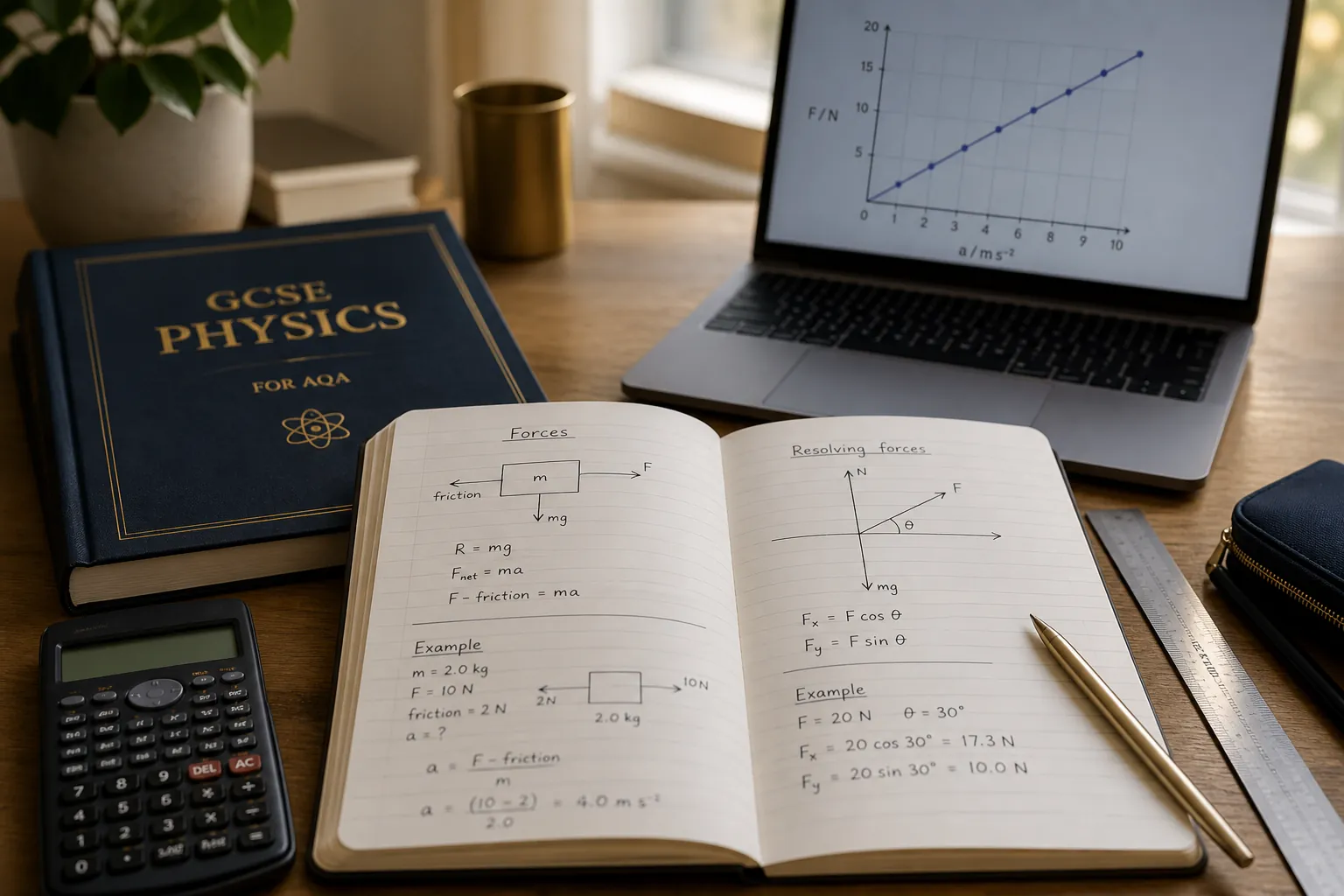
Physics is more mathematically demanding than Biology or Chemistry. Equations — and knowing when to apply which one — account for a significant proportion of available marks. Students who are uncertain about rearranging equations, converting between units, or selecting the right formula for a given scenario will consistently lose marks even when their conceptual understanding is sound.
The other challenge is the abstract nature of key topics. Forces, fields, waves, and electricity require students to reason about things they cannot directly observe. Without clear visual explanations and repeated practice applying the concepts, these topics remain vague rather than understood.
Higher-grade questions also require students to evaluate — to assess experimental design, suggest improvements, and explain phenomena using physics principles they have not been directly taught. This evaluative thinking is genuinely difficult and requires practice.
Our Approach
How Nexus GCSE Physics tutors work
Physics tutoring at Nexus begins with the diagnostic to identify whether the main difficulty is conceptual understanding, mathematical application, or exam technique. The approach differs meaningfully based on which of these is the primary barrier.
For mathematical difficulty, sessions address the specific equation types and calculation methods that are causing problems — with a focus on reliable method rather than memorisation. For conceptual difficulty, sessions use visual explanations, analogies, and worked examples that build understanding from first principles.
For exam technique, sessions focus on interpreting questions correctly, structuring extended answers, and using the mark scheme language Physics examiners reward.
94%
of Nexus Academy students hit their target grade
Syllabus Coverage
GCSE Physics topics we cover
Every topic taught is aligned to your child's specific exam board specification — Foundation or Higher tier, AQA, Edexcel, or OCR.
Forces & Energy
- Forces, Newton's laws and momentum
- Energy stores, transfers and efficiency
- Power and specific heat capacity
- Pressure and density
Waves & Electricity
- Properties of waves and the EM spectrum
- Reflection, refraction and sound
- Circuit components and resistance
- Series and parallel circuits
Magnetism & Atomic Structure
- Permanent magnets and electromagnets
- The motor effect and generators
- Radioactive decay and half-life
- Nuclear equations and uses of radiation
Space & Required Practicals
- Particle model and states of matter
- Space Physics and the Solar System (Higher)
- Red-shift and the expanding universe
- All required practicals for your exam board
Exam Board Specialists
Exam boards we cover
Your child is matched with a tutor who knows their specific exam board inside out — not a generalist who covers everything.
AQA GCSE Physics
Our tutors know AQA's equation list, the specific required practicals, and the way AQA structures calculation questions to test both method and reasoning.
Edexcel GCSE Physics
Including Edexcel's specific approach to extended writing questions and the way Higher tier questions reward explanations that link cause and effect precisely.
OCR GCSE Physics
Including both OCR Gateway and 21st Century Physics, which have distinct topic organisations. Our tutors work with the specific OCR specification your child's school follows.
Triple Science or Combined Science Physics — the content and exam differences
Triple Science GCSE Physics (AQA 8463) is a standalone GCSE examined through two 1 hour 45 minute papers. Combined Science Physics (AQA Trilogy 8464) is examined across two 1 hour 15 minute papers contributing to the double Combined Science grade. The core content is the same, but Triple Science Physics includes additional Higher-tier topics not assessed in Combined Science.
Triple-only Physics content
Triple-only Physics content includes:
Space physics (Topic 8) — the Solar System, life cycle of stars, red-shift and the expanding universe
More detailed treatment of electromagnetic induction and the generator effect
Additional content on turning effects and moments
Further nuclear physics including nuclear fission and fusion in greater depth
Space physics is the most frequently overlooked Triple-only topic — it is relatively short in content but appears reliably in Triple Physics papers. Students who prepare comprehensively for Combined Science content and assume it transfers entirely to Triple Science are often caught out here.
The GCSE Physics formula sheet in 2026
For 2026 and 2027, AQA provides a Physics Equations Sheet inside all GCSE Physics exam papers (8463 Triple, 8464 Combined). This covers equations students previously had to memorise. However, students must still know which equation applies to a given problem type, how to rearrange equations algebraically, and how to substitute values with correct units. The equation sheet changes what must be memorised — it does not change what must be understood.
The four-step calculation method AQA examiners still mark
AQA GCSE Physics examiner reports continue to flag the same calculation errors even with the equation sheet provided: selecting the wrong equation, incorrect rearrangement, unit conversion mistakes, and what examiners call "spurious conversions" — changing units that were never asked to be changed.
Nexus Academy tutors teach a four-step method used in every calculation session: (1) identify the physics principle, (2) select the correct equation from the sheet or memory, (3) rearrange with units written at each step, (4) substitute and round to the significant figures the question specifies. Method marks are awarded for showing this working — not just for the final numerical answer.
What GCSE Physics examiners consistently identify as the sources of lost marks
Spurious unit conversions. A distinctive error documented in AQA GCSE Physics examiner reports is what examiners call "spurious conversions" — students converting units that were never asked to be converted. A value given in kilograms that should be used in kilograms is converted to grams, producing a wrong answer. The exponent issue compounds this: students who know that 1 km = 1000 m but write the conversion incorrectly when squaring or cubing units (such as m² to cm²) lose marks through arithmetic errors introduced by unnecessary steps.
Equation selection and rearrangement under pressure. Physics papers test whether students can select the correct equation, rearrange it correctly, substitute values with appropriate units, and give an answer to the number of significant figures specified. Each of these is a mark. Students who know the physics but cannot reliably execute the four-step calculation process under timed conditions leave marks on the paper that their understanding should have earned.
Graph gradient and intercept questions. Both theory papers include questions that require students to calculate a gradient from a straight-line graph, interpret what the gradient represents physically, and read off intercept values. Students who draw lines of best fit that do not cover the full range of data, or who calculate gradients using individual data points rather than the drawn line, consistently lose these marks.
Six-mark questions without a plan. Extended response questions in Physics require a logical sequence — stating the physics principle, applying it to the scenario, explaining the cause-and-effect relationship, and concluding. Students who start writing without a mental plan produce answers that repeat points or miss the logical link the mark scheme rewards. AQA GCSE Physics (8463 Triple, 8464 Combined) is the most widely sat. Edexcel GCSE Physics (1PH0) tends to include more data-heavy questions requiring students to extract information from tables and graphs before applying physics equations. OCR GCSE Physics (Gateway J249, 21st Century J258) has two routes; students and parents should confirm which OCR route their school follows.
Inside a Session
What a typical GCSE Physics lesson looks like
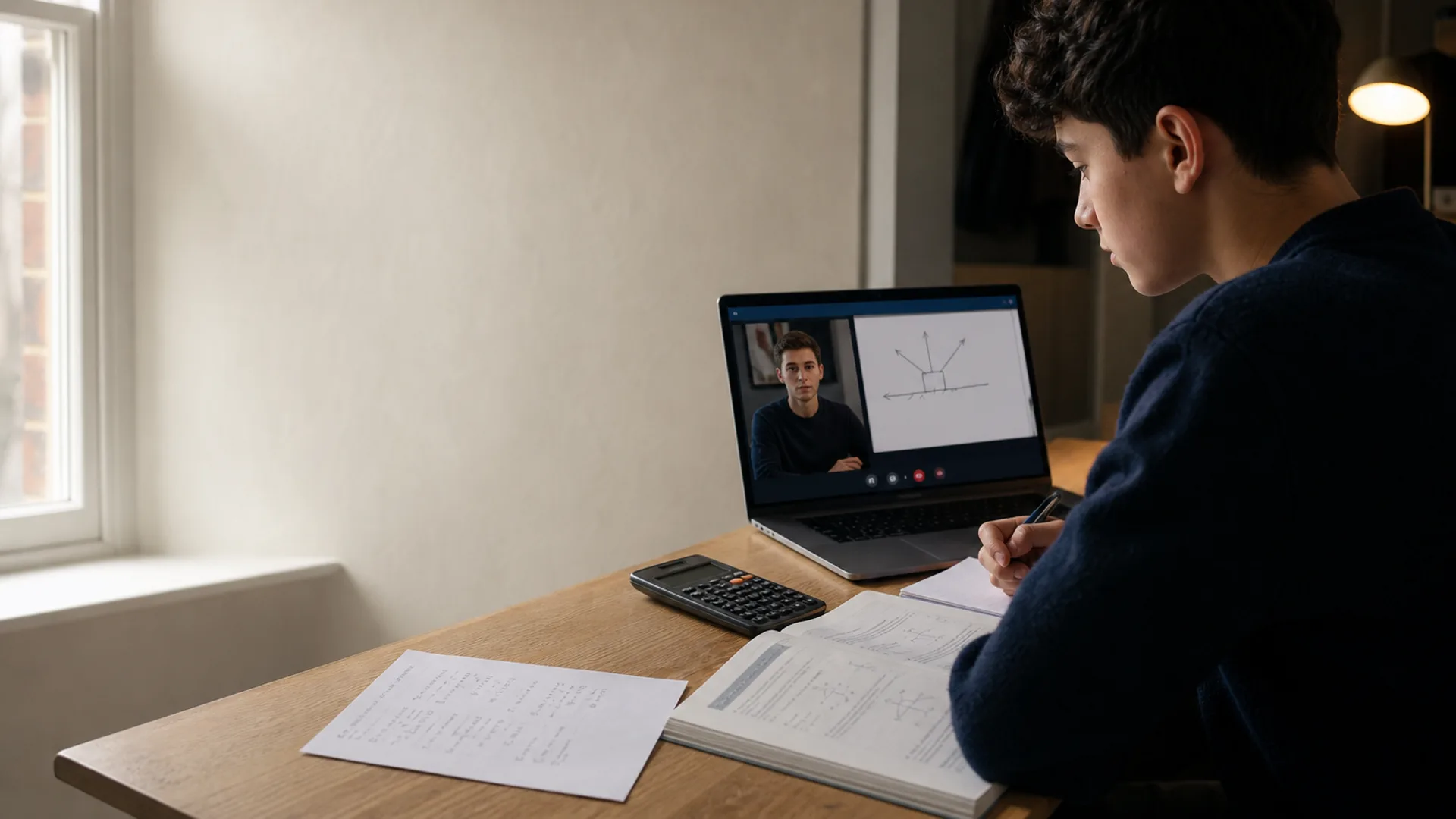
Physics sessions on the shared digital whiteboard focus heavily on diagrams, equation work, and step-by-step calculation practice. Your tutor demonstrates the method for a calculation type, walks through it together with your child, and then observes as your child attempts questions independently — intervening at the precise point where errors occur.
For conceptual topics, your tutor uses visual explanations to build a mental model — drawing force diagrams, wave patterns, and field lines in real time as they explain. The goal is for your child to be able to explain the physics in their own words, not just repeat a memorised answer.
“Physics was the subject holding my son back from the sciences combination he needed for sixth form. He understood most of it but completely fell apart on calculation questions. After eight sessions working specifically on electricity and forces calculations, he went from a grade 5 to a grade 7 in his mock. He sat the real exam with actual confidence.”
Common Questions
Frequently asked questions — GCSE Physics tutoring
Nexus Academy offers a GCSE Physics tutor online from £14 per hour for AQA, Edexcel and OCR. Sessions are one-to-one with a degree-educated physicist, a personalised plan, and monthly progress reports. There is no lock-in — cancel anytime after the free demo lesson. That £14 figure is Nexus Academy's academic floor for GCSE Physics, not a marketplace starting bid and not an agency rate of £50–70. You are matched to one physicist rather than browsing tutor profiles. The free demo diagnoses Triple or Combined Science, the 2026 equation sheet, units, and required practicals, so paid sessions attack the marks that are actually leaking. Most families book a weekly 60-minute lesson through Year 11 and add extra sessions before mocks. Compare that with typical UK GCSE tutoring around £35–45 per hour. Nexus Academy is a tutoring company: the price includes the lesson, the plan, and the reports, with no minimum block.
Nexus Academy is a UK tutoring company, not a marketplace or platform. We provide one-to-one GCSE Physics tutors — and tuition — online from £14 per hour, matched to AQA, Edexcel or OCR. The free demo confirms Triple or Combined Science and which calculation step is costing marks before any paid sessions. Parents searching "where can I find a GCSE Physics tutor online" are usually comparing directories; Nexus Academy matches you to one physicist instead. Sessions run on a shared digital whiteboard so equation selection, rearrangement, and unit conversion can be marked live. Tuition can start in Year 10 or as a Year 11 mock-recovery block. Book from anywhere in the UK — there is no city page and no in-person office. After the demo you receive a short plan covering equations, required practicals, and six-mark technique. Cancel anytime. The same £14 rate is on the pricing page, identical to the GCSE Physics hire FAQ.
Yes. The gap between understanding content and performing under exam conditions is very common in GCSE Physics. Nexus Academy tutors work on exam technique specifically — interpreting question wording correctly, selecting the right equation, showing method clearly, and structuring extended answers to match what the mark scheme rewards. Timed practice under realistic conditions is built into sessions as the exam approaches.
Yes. The equations a student must memorise versus those provided on the equation sheet vary by exam board. Nexus Academy tutors work with students on the specific equation list for their board — drilling recall where memorisation is required and practising application for all equation types. Students who are fluent with their equations consistently outperform those who are not.
Yes. Required practical questions appear across both papers in GCSE Physics and are a consistent source of lost marks. Nexus Academy covers all required practicals relevant to the student's exam board, including apparatus identification, method, variable control, and result analysis.
For 2026 and 2027, AQA GCSE Physics provides an equation sheet inside the exam paper covering the equations students previously had to memorise. The sheet includes equations such as wave speed, Ohm's law, power, and kinetic energy formulae. However, students still need to understand which equation to apply in a given context, how to rearrange equations algebraically, and how to handle units correctly — none of which the equation sheet replaces. Nexus Academy teaches equation application and rearrangement as a specific skill distinct from content knowledge.
Triple Science GCSE Physics (AQA 8463) is a standalone GCSE with two 1 hour 45 minute papers, and includes additional content not in Combined Science — notably Space Physics (Topic 8), more detailed electromagnetic induction, and further nuclear physics. Combined Science Physics is examined in two 1 hour 15 minute papers contributing to the double Combined Science grade. Both routes cover the same core content. Nexus Academy confirms which route your child is following during the diagnostic session and ensures all relevant content is covered.
Calculation questions in GCSE Physics reward four distinct steps: selecting the correct equation, rearranging it algebraically, substituting values with correct units, and rounding the answer to the specified number of significant figures. Students who lose marks on calculations despite understanding the underlying physics are typically failing consistently at one of these four steps — most commonly rearrangement or unit handling. Nexus Academy tutors identify exactly which step is causing mark loss and practise it specifically until it becomes reliable under timed conditions.
No. AQA confirms that a Physics Equations Sheet is provided in 2026 and 2027 GCSE Physics papers (8463), but questions still require students to know which equation applies, rearrange it correctly, and handle units under timed pressure. Nexus Academy teaches equation application and the four-step calculation method as distinct skills — the sheet supports recall, it does not replace understanding.
AQA Triple Science GCSE Physics (8463) includes Space Physics (Topic 8), deeper electromagnetic induction and generator content, and extended nuclear physics not examined in Combined Science Trilogy (8464). Nexus Academy confirms your child's route during the diagnostic and ensures Triple-only topics such as Space Physics are covered where relevant.
Still have questions? We're happy to help.
Equations leaking marks? GCSE Physics equations guide →
Full improvement plan: How to improve GCSE Physics →
Moving to A Level? See A Level Physics tutoring →
Studying IGCSE Physics? See our IGCSE Physics grade guide →
Start Today
Book a free GCSE Physics demo lesson
Your GCSE Physics tutor will diagnose whether marks are leaking on equations, units or required practicals — from £14/hr after the free demo. No payment required.
Book a Free Demo LessonFrom £14/hr · No commitment · Free first session