Quick answer
Moles, concentration and percentage yield at GCSE are a calculation method: identify the quantities given, pick the correct relationship, rearrange, convert units, then check significant figures. Nexus Academy coaches that method one-to-one from £14/hr — against official mark schemes, not invented shortcuts.
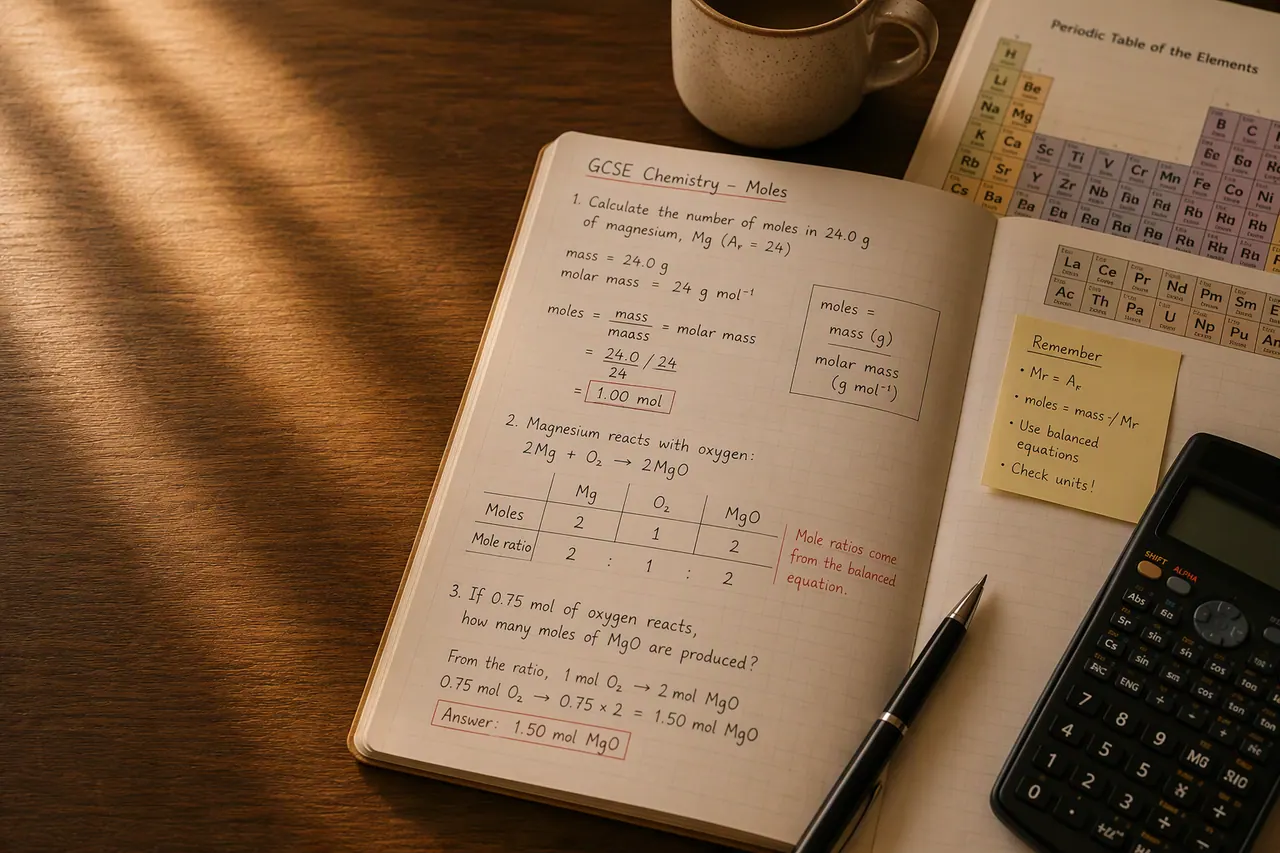
Moles questions are where capable Chemistry students quietly lose a grade. The content is not mysterious — amount of substance, concentration of solutions, and how much product you get versus the theoretical maximum. What fails is method: skipping a unit conversion, rearranging in the head, or writing a bald number with no working.
This page is a practice framework for parents and students. It is not an unofficial mark scheme. For board-matched tutoring, use GCSE Chemistry tutoring. When rearranging formulae is the real bottleneck, strengthen GCSE Maths in parallel.
A five-step calculation framework
| Step | Do this | Why examiners care |
|---|---|---|
| 1. List | Write what is given: mass, Mr, volume, concentration, moles… | Stops mixing up which quantity is unknown |
| 2. Choose | Pick the relationship that links those quantities (from the formula sheet / memory as required) | Wrong equation = zero even with neat arithmetic |
| 3. Rearrange | Change the subject on paper before substituting numbers | Method marks survive a calculator slip |
| 4. Units | Convert cm³ ↔ dm³ (÷ or × 1000) before concentration work | Classic one-mark leak on otherwise correct answers |
| 5. Finish | Significant figures / decimal places as asked; include units | Final answer marks; “show that” needs the path |
Confirm which formulae your board prints on the paper or data sheet — AQA, Pearson Edexcel and OCR are not identical in what they provide. Nexus Academy always checks the live specification first.
Moles, concentration and yield — what each question wants
Amount in moles. Link mass and molar mass (Mr), or use concentration × volume when working with solutions. Write the rearrange; do not jump to the calculator.
Concentration. Usually amount of solute ÷ volume of solution in dm³. Convert cm³ first. State units (e.g. mol/dm³) unless the question forbids them.
Percentage yield. Compare actual mass (or moles) of product to the theoretical maximum from the limiting reactant. Show which reactant limits before dividing.
Where marks leak (parent checklist)
| Pattern | What you see in the script | Fix in practice |
|---|---|---|
| Units | Volume left in cm³ inside a mol/dm³ calculation | Always convert before substituting |
| Rearranging | Correct formula written, wrong subject used | Triangle / algebra rearrange on paper every time |
| Significant figures | Calculator dump to 8 decimals when asked for 2 s.f. | Circle the s.f. instruction before calculating |
| No working | Final number only; arithmetic error kills the question | Method lines even when confident |
| Limiting reactant | Yield calculated from the excess reactant | Compare moles of each reactant first |
Practise with official past papers and mark schemes from your board — not random worksheet PDFs that invent mark allocations. Nexus Academy lessons mark against the live scheme so students see exactly where method marks sit.
When to add tutoring
If the same unit or rearranging error appears on three papers, more unmarked questions will not fix it. Book a free diagnostic via /book/ or start on GCSE Chemistry tutoring from £14/hr. Bring one recent paper; we build a short moles drill list from the actual leaks.
Frequently asked questions
How do you calculate moles at GCSE Chemistry?
Nexus Academy teaches moles via the mass–molar mass–amount relationship, with each rearrangement shown clearly for method marks. We treat it as a repeatable calculation method against your board’s formula sheet — not an unofficial mark scheme.
Why does my child lose marks on concentration and yield questions?
Nexus Academy sees marks leak on units (dm³ vs cm³), missed rearrangements and significant figures — not on “not understanding Chemistry”. We drill those habits in one-to-one sessions from £14/hr after a free diagnostic.
Do you need strong Maths for GCSE Chemistry moles?
Yes — Nexus Academy treats moles questions as applied Maths: ratios, rearranging formulae and unit conversions. We often pair Chemistry tutoring with Maths fluency work when algebra is the bottleneck.
Is this guide an official mark scheme?
No — Nexus Academy presents this as a parent-friendly step framework for practice; only your exam board’s published mark schemes award marks. Our tutors use those official AQA, Pearson Edexcel or OCR schemes in lessons.