Quick answer
Nexus Academy runs board-specific GCSE Maths November resit programmes from £14 per hour. AQA papers are 4, 6 and 9 November 2026. The eight weeks work if you stop generic revision and attack the topics and non-calculator habits that cost marks in June — after a free diagnostic, not a guess.
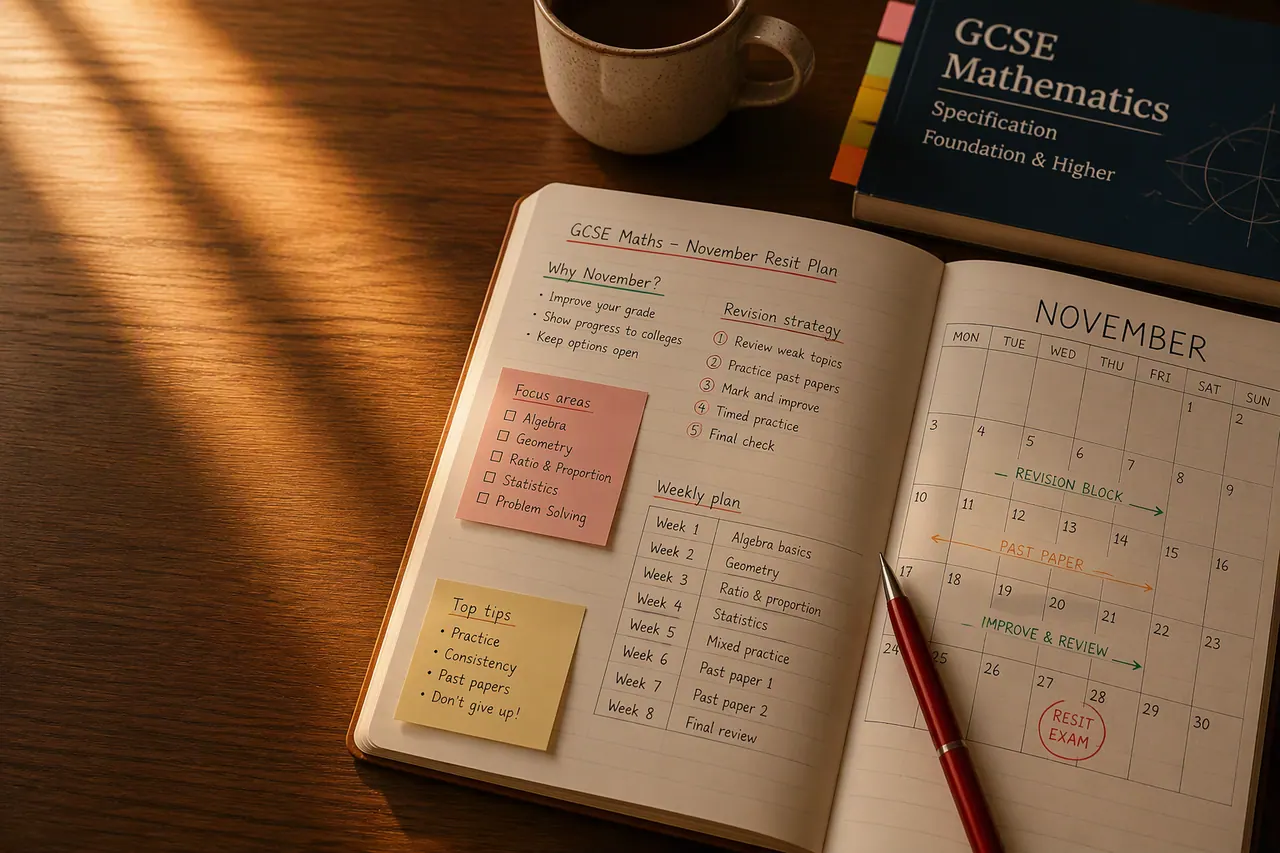
Maths is the November subject parents fear most because it is cumulative. A wobble on fractions in Year 9 still shows up on Paper 1. The good news is that summer scripts usually fail in clusters — ratio, algebra rearrangement, standard form, a missed method mark — not in “being bad at maths”.
Confirm the centre has entered your child before you buy a revision pack. Then book GCSE Maths tutoring against the live specification (AQA 8300, Pearson Edexcel 1MA1, or OCR J560). The year-round method — past papers, mark schemes, topic gaps — is already in how to improve GCSE Maths. This page is only the autumn sitting: eight weeks, three papers, one grade 4.
Confirm board, tier and Paper 1
Foundation caps at grade 5. Higher starts at 4 and goes to 9. A student who needed a 4 and is moved onto Higher without the algebra is how another 3 happens in January. Nexus Academy does not change tier. We prepare the papers on the entry the exams officer has already made.
Paper 1 is non-calculator on AQA, Pearson Edexcel and OCR. November candidates who lived on a calculator all summer lose the 4 here: written methods for percentages, fractions of amounts, estimation, standard form without a button, simple rearranging. Papers 2 and 3 allow a calculator; they still punish missing method marks and unread command words.
| AQA November 2026 | What it is | Length |
|---|---|---|
| Wed 4 Nov, morning | Paper 1 — non-calculator | 1 hour 30 minutes |
| Fri 6 Nov, morning | Paper 2 — calculator | 1 hour 30 minutes |
| Mon 9 Nov, morning | Paper 3 — calculator | 1 hour 30 minutes |
Other boards sit in the same JCQ window. Check your child’s actual codes with the exams officer — not with a screenshot from a forum.
Where a grade 3 usually leaked
Do not restart the whole specification. Examiner reports and November diagnostics at Nexus Academy keep hitting the same clusters for students sitting for a 4:
Number without a calculator. Fractions, percentages, estimation, factors and standard form on Paper 1. If this is weak, two calculator papers will not rescue the grade.
Ratio and proportion. Best-buy, recipes, exchange rates, and “share in the ratio”. High yield on Foundation; still leaks on Higher when the last step is missed.
Algebra rearrangement. Solving linear equations, substituting, and changing the subject. A single method-mark habit (show the inverse steps) often moves a high 3.
Shape that needed a diagram. Angles in parallel lines, area of compound shapes, Pythagoras used as a last resort. Students skip the sketch; the mark scheme does not.
The eight-week plan and how many hours
| Weeks | In the lesson | Between lessons |
|---|---|---|
| 1–2 | Diagnostic paper + Paper 1 methods | Short non-calculator drills, not a new textbook |
| 3–5 | The two or three topic clusters from June | Topic questions, then the same style in mixed order |
| 6–8 | Timed sections, then a full paper | Mark against the scheme; rewrite any dropped method |
A realistic block is eight 60-minute sessions (one a week) or sixteen if Paper 1 has collapsed. At Nexus Academy that is from £14/hr after a free first session — so roughly £112 or £224 before the papers, with no lock-in. If the diagnostic shows missing Foundation content across the specification, we will say so and point you at June rather than sell a crash that cannot land a 4. See November or June.
Command words still matter in week eight: “show that”, “estimate”, units, and rounding only at the end. Those habits are in the longer Maths guide; we drill them on the November papers, not as a theory lecture.
What the free diagnostic actually covers
The first Nexus Academy session is not a sales call. We confirm board and tier, mark a recent paper (or a section if time is short) against the official scheme, and write the three topic clusters for weeks 3–5. You leave with a plan you could follow even if you never booked again — most families then keep the weekly slot through 9 November.
Entries remain the centre’s job. The November series overview covers who can sit. How many hours GCSE tutoring usually takes over a year is a different question — how many hours of GCSE tutoring — this resit is a short, board-specific block.
Frequently asked questions
When is the GCSE Maths November 2026 resit?
AQA GCSE Maths in November 2026 is Paper 1 on 4 November, Paper 2 on 6 November and Paper 3 on 9 November, all morning sittings of 1 hour 30 minutes at Foundation and Higher. Nexus Academy tutors to the board your centre has entered — Pearson Edexcel and OCR use the same JCQ week.
Can you go from a 3 to a 4 in eight weeks of Maths tutoring?
Yes, when the summer scripts show a narrow gap — typically a handful of number and algebra topics plus non-calculator fluency. Nexus Academy starts with a diagnostic against the live specification, then weekly one-to-one sessions from £14/hr. A grade 1 or 2 with missing Core content usually needs the summer series, not a crash November.
Should a November resit stay on Foundation or move to Higher?
Stay on the tier the school entered unless the exams officer changes it. Foundation tops out at grade 5; a student who needed a 4 and sat Higher unprepared often drops below a 4. Nexus Academy does not change tier — we prepare the papers on the entry.
How many hours of Maths tutoring do you need for a November resit?
Nexus Academy usually books one 60-minute session a week for a high 3, or two a week when Paper 1 methods have collapsed. That is eight to sixteen hours before 4 November, from £14/hr, after a free diagnostic. More hours do not help if they are still generic worksheets instead of the leaked topics.