GCSE Computer Science
GCSE Computer Science Tutor Online — OCR, Python, From £14/hr
Looking for a GCSE Computer Science tutor online? Nexus Academy matches your child with a UK-qualified Computer Science specialist for OCR J277, AQA 8525 or Pearson 1CP2 — one-to-one from £14 per hour, with a free demo lesson and no lock-in.
Free first session · No payment details required
- From £14/hrone-to-one
- 94%hit their target grade
- 5 boardsOCR, AQA, Pearson Edexcel, Eduqas (WJEC), Cambridge
Quick answer
Nexus Academy offers a GCSE Computer Science tutor online from £14 per hour for OCR J277, AQA 8525 and Pearson 1CP2, with a free demo lesson and no lock-in.
Why Nexus Academy
One-to-one GCSE Computer Science tutoring that works
Nexus Academy is a UK tutoring company, not a marketplace or platform. You are matched to one Computer Science tutor who knows your child’s board — not a directory of profiles to browse.
The parent pattern we see most is “can use Scratch or copy a Python demo, then the mock Paper 2 collapses.” GCSE Computer Science is two different exams glued together: systems theory you can revise from notes, and algorithms you can only mark by writing, tracing and refining code under time. We diagnose which of those two is leaking marks, then practise it until it holds in a past paper.
Also preparing for A Level Computer Science →
The Challenge
Why GCSE Computer Science leaks marks even when students “get coding”
GCSE Computer Science is not a single skill. Paper 1 (systems) rewards precise definitions — CPU registers, MAC versus IP, the difference between encryption and hashing. Paper 2 rewards being able to design, write, test and refine a program the way that board prints it. Students who only practise one half leave the other half on the table.
Parents cannot usually mark this subject at home. A Maths worksheet has a right answer. A trace table that is one column short, or Python that works on the laptop but does not match OCR Exam Reference Language in the paper, still scores zero on the method the examiner is holding.
There is also a widespread myth that GCSE Computer Science still has a coursework project. Ofqual removed the NEA. Programming is examined in the papers. Schools sign a Practical Programming Statement to confirm students had the chance to design, write, test and refine programs — that statement is not a grade. Revising for a project that is not in the exam wastes the months that should go on trace tables, binary and past papers.
OCR Exam Reference Language is not Python.
OCR J277 prints algorithms in its own Exam Reference Language. Students may answer in that language or in a high-level language they know, but they must be able to read ERL on the paper. A student who has only ever seen Python meets unfamiliar notation in the hall.
Trace tables are where Paper 2 method marks sit.
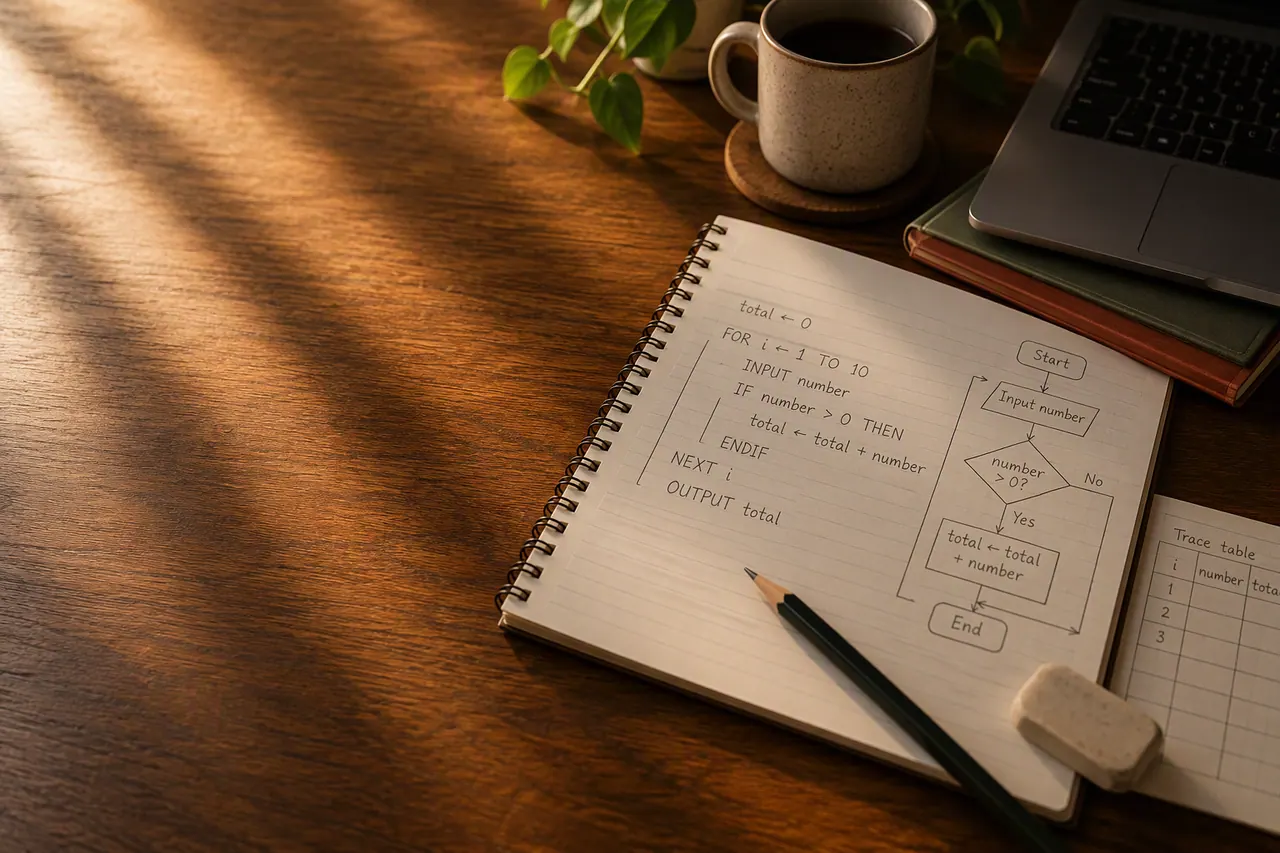
Examiners award marks for completing a dry run: identifier columns, each iteration, the final output. Students who “know what the code does” but skip rows, mix up = and ==, or invent output, lose the whole table — not one slip.
Binary and logic look like Maths but are marked as CS method.
Place-value errors in denary–binary–hex conversion, missing leading zeros, and truth tables with the wrong number of input combinations are among the most common Paper 1 losses. The arithmetic is simple; the method has to be exam-shaped.
Our Approach
How Nexus GCSE Computer Science tutors work
The free demo is a diagnostic, not a sales call. Your tutor confirms the live specification code — OCR J277, AQA 8525 or Pearson 1CP2 — and splits recent mock marks into systems recall, algorithm tracing, and live coding. That split decides the plan. A student who can define a MAC address but cannot complete a nested-loop trace does not need another hour on networks.
Sessions then follow that plan on a shared editor and whiteboard. For OCR, we write the algorithm in Python for fluency, then immediately rewrite the same logic in Exam Reference Language so the paper does not feel like a foreign dialect. For AQA, we practise the programming paper in the language the school actually teaches — almost always Python 3. For Pearson 1CP2, we practise on-screen Python the way Paper 2 is sat, including the IDE habits the on-screen exam rewards.
As mocks approach, sessions switch to timed past-paper sections and examiner-report patterns: incomplete trace tables, validation and testing marks left blank, six-mark ethics answers that rant instead of using the command word. Parents get a monthly written note of which topics are secure and which still leak.
Monthly progress report
ExampleShared with parents
GCSE Computer Science · topics secured
- Computer systems
- Networks, security and ethics
- Data representation
- Algorithms and programming
Syllabus Coverage
GCSE Computer Science topics we cover
Every topic taught is aligned to your child's specific exam board specification — Foundation or Higher tier, AQA, Edexcel, or OCR.
Computer systems
- CPU: ALU, CU, registers, cache, clock speed, cores
- Von Neumann architecture and the fetch–decode–execute cycle
- Primary and secondary storage; embedded systems
- System software: OS functions, utilities, drivers
Networks, security and ethics
- LAN/WAN, star and mesh, wired vs wireless
- Protocols, IP vs MAC, DNS, packet switching
- Threats, malware, encryption, SQL injection
- Legal, ethical, cultural and environmental impacts
Data representation
- Binary, denary, hexadecimal conversions
- Binary addition and overflow; two’s complement where on spec
- Characters, images (pixels, colour depth, metadata) and sound
- Compression: lossy vs lossless
Algorithms and programming
- Computational thinking: abstraction, decomposition, algorithms
- Flowcharts, pseudocode, OCR Exam Reference Language
- Sequence, selection, iteration; arrays/lists; string handling
- Searching and sorting: linear, binary, bubble, merge, insertion
- Testing, syntax vs logic errors, trace tables, SQL where on spec
Exam Board Specialists
Exam boards we cover
Your child is matched with a tutor who knows their specific exam board inside out — not a generalist who covers everything.
OCR GCSE Computer Science (J277)
The specification most UK schools associate with GCSE Computing. Two 80-mark papers, 1 hour 30 minutes each, no calculator. J277/01 is computer systems. J277/02 is computational thinking — Section A on concepts, Section B on designing, writing, testing and refining programs. Code in the paper is printed in OCR Exam Reference Language.
AQA GCSE Computer Science (8525)
Paper 1 is a two-hour programming paper (computational thinking and programming skills). Paper 2 is computing concepts. AQA allows Python 3, C# or VB.NET in the programming assessment — we match the language the school teaches, almost always Python 3, and drill design, write, test and refine against AQA’s paper style.
Pearson Edexcel GCSE Computer Science (1CP2)
Paper 1 is a written principles paper. Paper 2 is a two-hour on-screen Python exam. Centres must confirm students had Python practice via a Practical Programming Statement. We prepare 1CP2 students on-screen, not only on paper, because that is how the marks are awarded.
Eduqas (WJEC) GCSE Computer Science
Eduqas is WJEC's England-facing brand, sat in schools across England and Wales. Our tutors teach to the specification your school actually entered you for, including its own question style and mark scheme.
Cambridge GCSE Computer Science
Cambridge International qualifications are sat at international schools and by UK private candidates. Our tutors cover the Cambridge route alongside the English boards.
OCR J277, AQA 8525 and Pearson 1CP2 — how the three GCSE Computer Science boards actually differ
The DfE subject content is shared. The papers are not. Revising with the wrong board’s past papers trains habits that cost marks on the day — especially OCR Exam Reference Language versus AQA’s written programming paper versus Pearson’s on-screen Python exam. Nexus Academy confirms the specification code before any paid sessions.
OCR J277 — two 80-mark papers, Exam Reference Language on the page
J277/01 Computer systems is 1 hour 30 minutes, 80 marks, 50%, no calculator. It covers systems architecture, memory and storage, networks, security, systems software, and ethical, legal, cultural and environmental impacts. The eight-mark extended response at the end of Paper 1 is where students who can list facts still lose a level because they do not plan an argument against the command word.
J277/02 Computational thinking, algorithms and programming is also 1 hour 30 minutes and 80 marks. Section A (50 marks) tests algorithms, programming fundamentals, robust programs, Boolean logic, and translators/IDEs. Section B (30 marks) is the practical programming section: design, write, test and refine. All code printed in the paper uses OCR Exam Reference Language. Students may answer in ERL or in a high-level language, but they cannot sit the paper if they cannot read ERL.
There is no NEA and no programming project to send off. The school submits a Practical Programming Statement. Marks come from the two papers. Nexus tutors teach Python for fluency and ERL for the exam, on the same algorithm, in the same session.
AQA 8525 — a two-hour programming paper plus a concepts paper
AQA Paper 1 (computational thinking and programming skills) is 2 hours and 90 marks — 50% of the GCSE. It is where design, write, test and refine are examined in a real language. AQA supports Python 3, C# and VB.NET. In practice most centres teach Python 3; we confirm the language in the diagnostic and do not switch a student onto a language their school does not use.
Paper 2 (computing concepts) is 1 hour 45 minutes and 90 marks. Data representation, computer systems, networks, cyber security, databases and SQL, and the ethical/legal topics live here. SQL and relational databases are a distinctive AQA weighting compared with OCR’s lighter database demand.
AQA students who only “practise coding on Replit” and never sit a two-hour Paper 1 under timed conditions are the ones who run out of time on the refine-and-test questions. We time Paper 1 sections from the second month of a Year 11 programme.
Pearson 1CP2 — written principles plus an on-screen Python exam
Paper 1 (Principles of Computer Science) is a written paper, 1 hour 30 minutes, 75 marks, 50%. Paper 2 (Application of Computational Thinking) is 2 hours, 75 marks, 50%, sat on-screen in Python. That on-screen paper is the reason 1CP2 students need a different lesson shape: they must be fluent in the exam IDE, not only in a classroom notebook.
Pearson requires a Practical Programming Statement confirming each candidate had the opportunity to design, write, test and refine programs in Python. Failure to submit that statement is a centre administration issue — it is not a student coursework grade. Families searching “GCSE Computer Science NEA” for 1CP2 are usually reading pre-2022 advice.
Practical note for parents: Ask the school for the exact specification code (J277, 8525 or 1CP2) and, for AQA, the programming language taught. Bring the last mock and the mark scheme to the free demo. Do not buy a revision guide for a different board — OCR ERL practice does not prepare an AQA Paper 1, and AQA paper booklets do not prepare Pearson’s on-screen exam.
What each GCSE Computer Science paper is actually testing
OCR J277/01 — Computer systems · 1h 30 · 80 marks · 50%
Definitions, comparisons and the eight-mark extended response. Marks leak on imprecise terms (encryption vs hashing, MAC vs IP, RAM vs cache) and on ethics answers that give an opinion without applying the scenario. Nexus drills command words and forces a four-sentence plan before the long question.
OCR J277/02 — Algorithms and programming · 1h 30 · 80 marks · 50%
Section A (50) is concepts: complexity of algorithms, Boolean logic, data types, file handling. Section B (30) is practical programming. Trace tables, completing code, identifying test data (normal, boundary, erroneous) and writing a short program are the recurring mark-winners. We practise Section B weekly once Year 11 mocks start.
AQA 8525 Paper 1 — Programming · 2 hours · 90 marks · 50%
The paper that separates students who can talk about code from students who can produce it under time. Design (structure diagrams, pseudocode), write, test and refine are all examined. A two-hour sit needs stamina; we build that with timed sections, not only ten-minute drills.
Pearson 1CP2 Paper 2 — On-screen Python · 2 hours · 75 marks · 50%
Sat at a computer. Students who only write Python on paper for 1CP2 are practising the wrong exam. Nexus uses a shared editor so debugging, indentation and runtime errors are marked the way the on-screen paper marks them.
What GCSE Computer Science examiners keep flagging
OCR, AQA and Pearson examiner reports return to the same failures. They are not “not trying.” They are method habits that one-to-one tutoring can rewrite.
Incomplete trace tables. Missing identifier columns, skipping an iteration, or writing the final output without the intermediate values. A correct intuition with an incomplete table scores far below a slower student who fills every cell. We teach trace tables as a grid with rules, not as “run it in your head.”
Treating OCR Exam Reference Language as optional. Students who cannot parse assignment, selection and iteration in ERL misread the question before they write a single line of Python. Nexus always reads the printed algorithm first, then translates.
Binary conversion without place-value working. Wrong nibble grouping for hex, dropped leading zeros, and binary addition that forgets the carry into overflow. Method marks exist for showing place values. We insist on the column headings 128–1 every time, even when the student “just knows it.”
Validation, authentication and testing left blank. Presence, range and type checks, and normal / boundary / erroneous test data, are cheap marks on Paper 2. Students racing to finish a write-a-program question skip them. We put test data on the plan before the code, because that is the order the mark scheme often uses.
Six- and eight-mark ethics questions without a plan. Legal, cultural, environmental and privacy questions reward both sides and a judgement tied to the scenario. A rant about “AI stealing jobs” with no stakeholder and no law named stays in the bottom level. Nexus uses a three-bullet plan: stakeholder, impact, counter — then write.
Inside a Session
What a typical GCSE Computer Science lesson looks like
Sessions are live one-to-one online. Your tutor uses a shared editor and a digital whiteboard — code on one side, trace table or binary working on the other — so errors are caught at the line they happen, not in a marked book a week later.
A typical 60-minute OCR session might open with a five-minute binary or logic starter, move into a J277/02 Section B task (complete the algorithm, then trace it), then finish with a short J277/01 definition cluster from last week’s weak topic. AQA sessions weight more time toward the two-hour programming paper. Pearson 1CP2 sessions are spent in the editor the way Paper 2 is sat.
Between lessons students get a short, named task: one past-paper question, one trace table, or eight conversion drills — not a vague “practise Python.” Parents see what was set. As the exam approaches, full timed sections replace the starter-and-drill shape.

Working Method
How Nexus tutors teach Computer Science
Sessions are built around past papers and the mark scheme your exam board actually uses — not a generic syllabus. Your tutor works through questions with you, marks them as an examiner would, and shows exactly where the marks were won and lost.
That worked material becomes the record of progress: what is secure, what is still shaky, and what next month’s plan has to cover. It is the same evidence that goes into the monthly report parents receive.
“Our daughter could copy Python from class but froze on the OCR mock — she could not read the exam language on the paper. Eight weekly sessions that translated every algorithm into both Python and OCR’s reference language took her from a 5 to an 8 in the January mock. She started attempting Section B without asking us to sit with her, which is how we knew it had stuck.”
Common Questions
Frequently asked questions — GCSE Computer Science tutoring
Nexus Academy offers a GCSE Computer Science tutor online from £14 per hour for OCR J277, AQA 8525 and Pearson 1CP2. Sessions are one-to-one with a degree-educated Computer Science specialist, a personalised plan, and monthly progress reports. There is no lock-in — cancel anytime after the free demo lesson. That £14 figure is Nexus Academy’s academic floor for GCSE Computer Science, not a marketplace starting bid and not an agency rate of £50–70. You are matched to one tutor rather than browsing profiles. The free demo diagnoses the board, Paper 2 programming versus systems theory, and whether OCR Exam Reference Language is the block, so paid sessions attack the marks that are actually leaking. Most families book a weekly 60-minute lesson through Year 11 and add extra sessions before mocks. Compare that with typical UK GCSE tutoring around £35–45 per hour. Nexus Academy is a tutoring company: the price includes the lesson, the plan, and the reports, with no minimum block.
Nexus Academy is a UK tutoring company, not a marketplace or platform. We provide one-to-one GCSE Computer Science tutors — and tuition — online from £14 per hour, matched to OCR J277, AQA 8525 or Pearson 1CP2. The free demo confirms the specification code and whether trace tables, binary, or live coding is costing marks before any paid sessions. Parents searching “where can I find a GCSE Computer Science tutor online” are usually comparing directories; Nexus Academy matches you to one specialist instead. Sessions run on a shared editor and whiteboard so Python, OCR Exam Reference Language, and on-screen Pearson Paper 2 habits can be marked live. Tuition can start in Year 10 or as a Year 11 mock-recovery block. Book from anywhere in the UK — there is no city page and no in-person office. After the demo you receive a short plan covering systems, algorithms, and the paper your child actually sits. Cancel anytime. The same £14 rate is on the pricing page.
No. Nexus Academy prepares GCSE Computer Science as two examined papers. Ofqual removed the NEA; programming is assessed in the written or on-screen exam, and schools only sign a Practical Programming Statement to confirm students had classroom practice. Families still searching for “GCSE Computer Science NEA” are reading pre-reform advice. We put that time into trace tables, past papers and the language the board prints.
Nexus Academy matches the language to the board. OCR J277 students need to read Exam Reference Language and may write answers in ERL or Python. AQA 8525 allows Python 3, C# or VB.NET — we use whatever the school teaches, almost always Python 3. Pearson 1CP2 Paper 2 is on-screen Python only. Switching language without the school’s agreement wastes exam technique.
No. Nexus Academy treats GCSE Computer Science as a single 9–1 course. There is no Foundation/Higher split like GCSE Maths. The grade range is 9 to 1 on one set of papers per board. The diagnostic looks at topic gaps and paper technique, not tier entry.
Yes. Nexus Academy sees this often: Computing teacher shortages mean non-specialists are covering GCSE Computer Science. One-to-one sessions supply the missing programming feedback loop — live marking of trace tables, ERL, and test data — that a mixed-ability class cannot. The free demo maps what class has covered against the live specification so we do not reteach the whole course from scratch.
Nexus Academy typically sees a clear mock-paper movement within two to three months of weekly sessions when the diagnostic has identified a specific leak — usually Paper 2 tracing or Paper 1 binary/logic. Systems-theory gaps close faster than programming fluency. The free demo gives a realistic window against the exam date; we do not promise a grade 9 from a 4 in six weeks.
Nexus Academy confirms the code first because the papers differ more than the topic list. OCR J277 uses two 80-mark papers and prints code in Exam Reference Language. AQA 8525 uses a two-hour programming paper plus a concepts paper. Pearson 1CP2 examines programming on-screen in Python. Content overlaps; exam technique does not transfer cleanly between boards.
Nexus Academy treats GCSE Computer Science as strongly recommended, not a legal requirement. Most sixth forms want it, or a high Maths grade plus evidence of programming. Students jumping to A Level without GCSE CS need a summer bridge on programming and algorithms — we flag that in the diagnostic rather than pretending Year 12 will teach from zero.
Still have questions? We're happy to help.
Moving to sixth form? See A Level Computer Science tutoring →
International school? See IGCSE Computer Science tutoring →
Binary feels like Maths? GCSE Maths tutoring →
Which CS board? OCR vs AQA vs Edexcel Computer Science →
Paper 2 leaking? GCSE Computer Science Paper 2 →
Need a weekly plan? How to improve GCSE Computer Science →
Comparing boards in general? AQA vs Edexcel vs OCR →
Comparing quotes? GCSE tutor cost in the UK →
Explore more tutoring
Same subject, other levels
Other GCSE subjects
Start Today
Book a free GCSE Computer Science demo lesson
Your tutor will confirm J277, 8525 or 1CP2 and whether marks are leaking on trace tables, binary or live coding — from £14/hr after the free demo. No payment required.
Book a Free Demo LessonFrom £14/hr · No commitment · Free first session
Prefer WhatsApp? Message us directly →