Quick answer
Strong GCSE Maths students often wobble in Year 12 because A Level rewards fast algebra fluency and multi-step reasoning, not just past-paper familiarity. Nexus Academy starts with a 10-minute no-calculator algebra triage, then protects daily 15–20 minute algebra practice — A Level Maths tutoring from £18/hr after a free diagnostic.
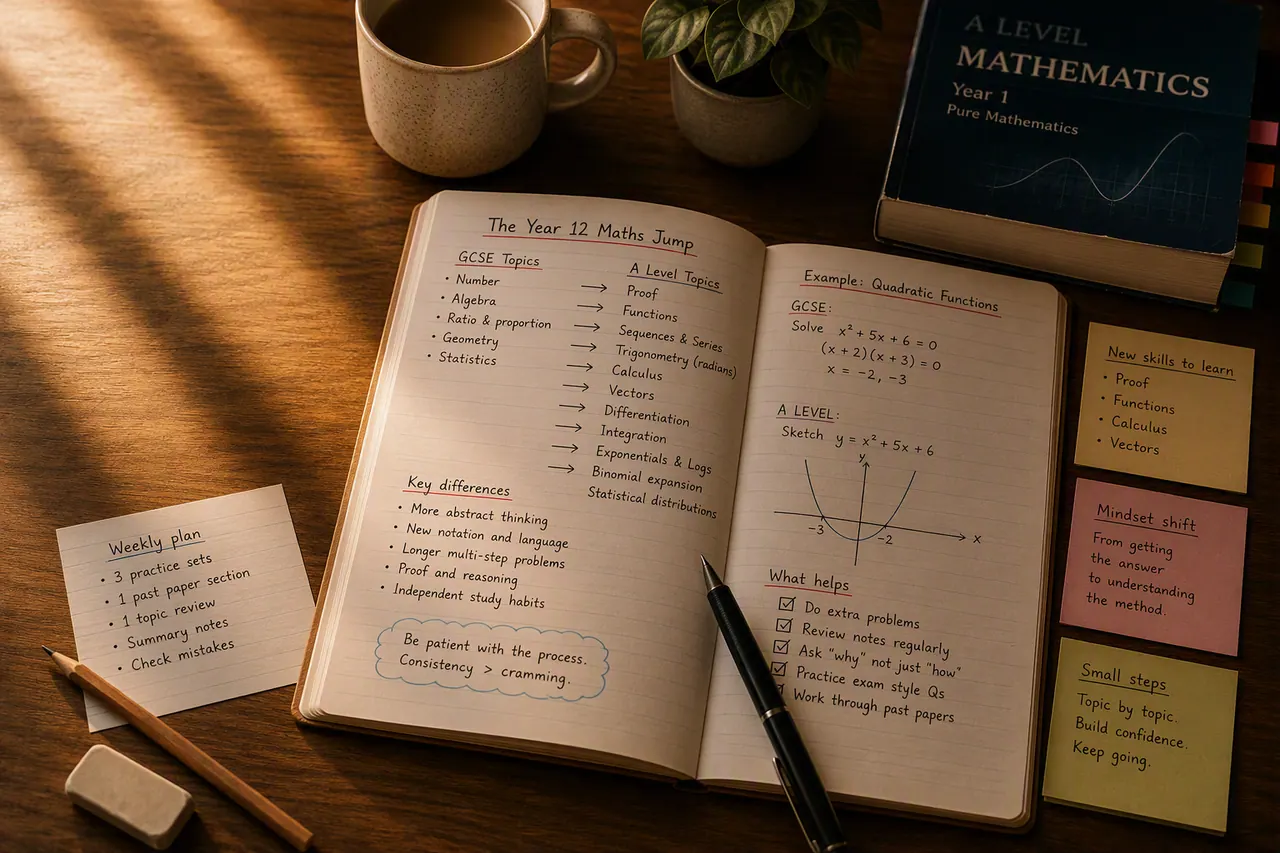
Parents are often blindsided: the child who sailed to an 8 or 9 suddenly calls A Level Maths “impossible” by half-term. That is rarely a story about intelligence collapsing over the summer. It is a story about speed. GCSE Higher still gives time to recover from a messy rearrangement. Year 12 Pure assumes indices, surds, factorising and changing the subject are automatic — then stacks differentiation or trig on top.
If they are still choosing GCSE tier, read GCSE Maths Foundation or Higher. Once they are in sixth form, the money page is A Level Maths tutoring — not another round of generic GCSE worksheets.
The real cause: fluency, not “not being clever”
Algebra that needs a calculator crutch. If every linear rearrange or index law needs a device or a long pause, Pure questions run out of time before the new idea starts.
Multi-step questions without a plan. A Level marks often sit in the middle steps. Students who “get the topic” still drop method marks when they cannot chain three GCSE skills in one question.
Homework volume without triage. Piling on more A Level exercises when algebra is shaky digs the hole deeper. Fix the base first, then return to the week’s Pure or Applied work.
October triage parents can run at the kitchen table
Before buying another textbook, spend ten minutes. No calculator. Ask for clean rearrangements, index laws, surds, quadratic factorising, and changing the subject. If those stall, the A Level content is not the first problem.
| Check | What “pass” looks like | If it fails |
|---|---|---|
| 10-min algebra (no calc) | Fluent rearranging and indices without long pauses | Daily 15–20 min algebra before extra A Level homework |
| One multi-step Pure Q | Shows method steps even when stuck on the last line | Coach structure — not more unmarked questions |
| Teacher feedback | Specific topics named (e.g. differentiation setup) | Book a diagnostic against that list |
Nexus Academy’s free diagnostic mirrors this: board and course (AQA / Edexcel / OCR / MEI where relevant), algebra speed, then the first-wall topics below. Tutoring is from £18/hr with no lock-in — most families keep one weekly slot while daily algebra stays at home.
First-wall topics (conceptual, not a full syllabus dump)
These are the places Year 12 often hits the wall when GCSE fluency is thin. This is not an exhaustive curriculum list — it is where parents usually hear “I don’t get it” first:
| Area | What goes wrong | Fluency fix first |
|---|---|---|
| Differentiation | Students memorise rules but cannot simplify the expression they start with | Indices, expanding, factorising |
| Trig identities | Formula sheet is open but algebra to rearrange stalls | Fractions of algebra, common denominators |
| Mechanics | SUVAT or forces feel “Physics-y” when the algebra of resolving is slow | Rearranging formulae; directed numbers |
| Statistics | Calculator stats modes hide weak probability language | Reading tables; precise wording of events |
| Proof / “show that” | Blank page when the question does not ask for a final number | Writing steps; working backwards from the target |
What to book — and what not to
Do not restart the whole GCSE Higher course in Year 12. Do protect daily algebra, keep teacher feedback visible, and use one-to-one time on the first-wall topic of the week. Book a free session at /book/ or go straight to A Level Maths tutoring — from £18/hr, board-matched, no lock-in.
Frequently asked questions
Why do strong GCSE Maths students struggle in Year 12?
Nexus Academy finds the Year 12 jump is usually algebra fluency and multi-step structure — not a sudden loss of ability after a grade 8 or 9. We diagnose that with a short no-calculator algebra check, then rebuild daily practice before more A Level homework.
What should parents do if Year 12 Maths feels impossible by October?
Nexus Academy recommends a 10-minute no-calculator algebra triage, then 15–20 minutes of daily algebra before extra homework volume. That triage is part of our free diagnostic so tutoring targets the wall, not a random topic list.
Is A Level Maths tutoring worth it after a GCSE 8 or 9?
Yes — Nexus Academy A Level Maths tutoring from £18/hr helps when marks leak on rearrangement, indices, surds or multi-step questions despite “knowing” the new content. The free first session focuses on fluency, not re-teaching GCSE from scratch.
Does Foundation or Higher GCSE matter for A Level Maths?
Nexus Academy treats Higher-tier algebra depth as the normal base for A Level Maths; Foundation alone is rarely enough preparation for Year 12. We still start from where the student is now — see our Foundation or Higher guide for GCSE context, then book A Level support in sixth form.