Quick answer
Combined Science is two GCSEs (a double grade such as 6-6). Triple Science is three separate GCSEs in Biology, Chemistry and Physics. Most sixth forms accept strong Combined grades for A Level science; medicine does not require Triple. Nexus Academy tutors both pathways from £14/hr after a free diagnostic — choose on workload and school entry rules, not status.
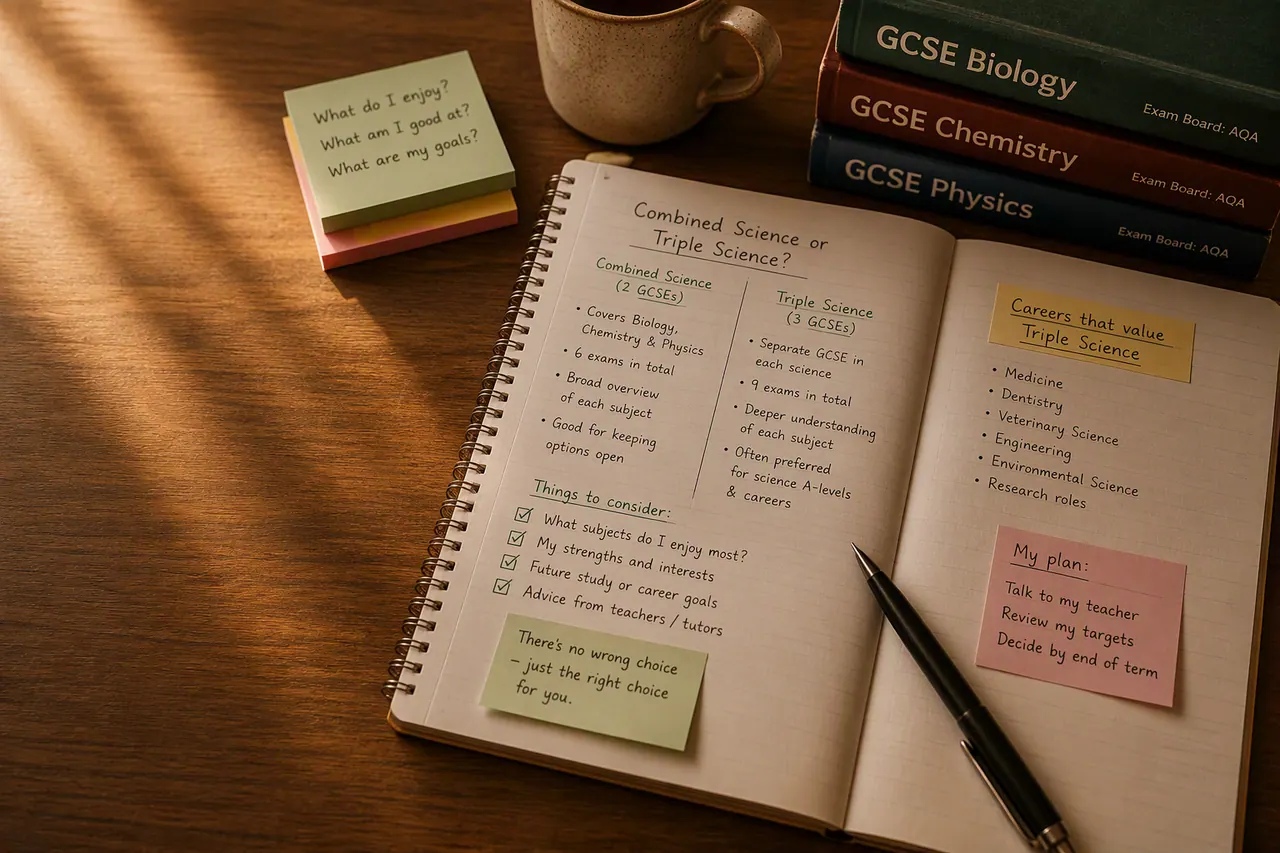
If your child is in Year 8–10, options evening will push this decision hard. If they are already in Year 11, the anxiety shifts: “Did we pick the wrong route for sixth form?” Both questions deserve a calm, commercial answer — not a panic about medicine or “looking clever”.
Nexus Academy is a tutoring company, not a school. We do not choose your child’s pathway. We do prepare the papers your centre has entered, whether that is Combined Science or the separate sciences — Biology, Chemistry and Physics.
What Combined and Triple actually award
Combined Science covers Biology, Chemistry and Physics in one course and awards two GCSEs — reported as a double grade (for example 7-6 or 5-5). Triple Science awards three GCSEs: one each in Biology, Chemistry and Physics, with more content per subject.
On AQA, Combined is usually Trilogy (subject-shaped papers) or, less often, Synergy (themed papers). Both are still two GCSEs. Confirm the exact specification code with the exams officer before you buy revision guides.
| Factor | Combined Science | Triple Science |
|---|---|---|
| GCSEs awarded | Two (double grade, e.g. 6-6) | Three separate grades |
| Content depth | Core across all three sciences | Extra topics in each science |
| Typical timetable | Often fits a standard option block | Usually uses an extra option slot |
| Sixth-form science | Often 6-6 (or similar) for A Level entry | Often grade 6 in that separate science |
| Workload | Heavy — but one integrated course | Heavier — three full GCSE courses |
| Medicine myth | Does not block medicine if A Levels follow | Not required for medicine applications |
The medicine myth — and what sixth forms actually ask
“You must do Triple for medicine” is the line that scares Year 9 options evenings. Medical schools care about A Level Biology and Chemistry (and usually a third rigorous subject), interview and admissions tests — not whether GCSE Science was Combined or Triple. A student with Combined 7-7 who thrives at A Level is in a stronger position than a Triple student who is drowning by Christmas of Year 12.
Sixth-form entry is local. A common pattern is around 6-6 in Combined, or grade 6 in the separate science you want to continue. Some colleges ask higher; some accept 5-5 with conditions. Read the prospectus. Then see A Level science after Combined for the Year 12 jump — Combined does not mean “locked out of science”.
Workload, options blocks and required practicals
Triple usually costs an options subject — languages, humanities or a creative course your child may also need. Combined frees that slot. That is a genuine trade-off, not a failure. If your child already struggles to keep homework current across Maths, English and two other GCSEs, Triple is not a badge of honour; it is three full courses competing for the same evenings.
Both routes include required practicals assessed in written papers, not as a separate coursework grade. How those practicals appear in exams is covered in GCSE Science required practicals. Combined and Triple students still need method, variables and graph skills — Triple simply has more content wrapped around them.
Checklist: choose Combined
- Your child wants a strong science set of grades without sacrificing another GCSE option.
- Homework already fills evenings — three separate science courses would tip them over.
- Sixth-form plans are open, or science A Levels look possible with Combined 6-6 (or your college’s published bar).
- The school timetable only offers Combined in their pathway, and fighting for Triple would mean moving schools or private entry.
- Interest in science is solid but not “I want three separate science GCSEs for their own sake”.
Checklist: choose Triple
- Your child enjoys the detail in all three sciences and wants the fuller separate specifications.
- There is spare capacity in the options block (or they willingly drop another subject).
- They are consistently strong in science assessments now — not “hoping Triple will force them to work harder”.
- Your preferred sixth form lists separate-science grades clearly, and Triple aligns with that route.
- You have a plan for revision support if one of the three sciences starts to slip — Triple grades are independent.
How Nexus Academy helps either pathway
The free diagnostic confirms board, Combined vs Triple, and which science is leaking marks. Weekly one-to-one sessions from £14/hr then target those gaps — equations in Physics, moles in Chemistry, or extended response in Biology — against the live papers. We will not sell Triple tutoring to a Combined student, or pretend Combined cannot lead to A Level science.
Already in Year 11 and worried the pathway was wrong? Focus on the grades your sixth form asks for. Strong Combined results open doors; weak Triple grades close them. Tutoring time should go into the papers your child will actually sit.
Frequently asked questions
Is Combined Science two GCSEs or three?
Nexus Academy treats Combined Science as two GCSEs — a double grade such as 6-6 or 5-4 — tutored as one programme across Biology, Chemistry and Physics, not three separate GCSE grades.
Do you need Triple Science to study medicine?
Nexus Academy is clear: you do not need Triple Science for medicine — medical schools look at A Level Biology and Chemistry (and often a third science or Maths), not Combined versus Triple at GCSE. Strong Combined students reach those A Levels when sixth-form entry grades are met.
What grades do sixth forms want for A Level science?
Nexus Academy plans Y11 tutoring against your child’s published sixth-form rules — many ask for roughly 6-6 in Combined Science, or grade 6 in the separate science you want to continue. Always check the college prospectus rather than a national average.
What is the difference between AQA Trilogy and Synergy?
Nexus Academy matches tutoring to whichever Combined route your centre entered: both Trilogy and Synergy are worth two GCSEs, but Trilogy keeps Biology, Chemistry and Physics as distinct papers while Synergy groups content into broader themes. Trilogy is the more common pathway.
Is Triple Science much more homework than Combined?
Nexus Academy expects Triple to mean more homework — three full GCSE courses versus one integrated Combined programme. We help families decide whether that extra depth is worth it for a student who already has a full option block, not whether Triple “looks better” on paper.