GCSE Maths
GCSE Maths Tutor Online — From £14/hr, Your Board
GCSE Maths is the subject parents worry about most — and for good reason. It is one of only two subjects that universities, employers, and colleges all require a pass in, regardless of what a student wants to do next. A grade 4 keeps doors open. A grade 7 or above opens significantly more of them.
From £14/hr · AQA, Edexcel & OCR · Free first session
Why Nexus Academy
One-to-one GCSE Maths tutoring that works
GCSE Maths is the subject parents worry about most — and for good reason. It is one of only two subjects that universities, employers, and colleges all require a pass in, regardless of what a student wants to do next. A grade 4 keeps doors open. A grade 7 or above opens significantly more of them.
At Nexus Academy, our GCSE Maths tutors are degree-educated mathematicians with real teaching experience. They know the AQA, Edexcel, and OCR specifications inside out — the topics most likely to appear, the mark schemes examiners use, and the specific mistakes that cost students marks at grade boundaries. Every student gets a plan built around their exact gaps, not a generic maths programme.
Also preparing for A Level Maths →
The Challenge
Why so many students get stuck in GCSE Maths
GCSE Maths is cumulative. Every new topic builds on something that came before — and if the foundation is shaky, the whole structure wobbles. A student who never fully grasped fractions in Year 8 will struggle with algebra. A student who is uncertain about algebra will find quadratics impenetrable. By Year 10, those foundational gaps can feel overwhelming.
The other issue is confidence. Maths is uniquely unforgiving — you either get the right answer or you do not — and repeated wrong answers erode a student's belief in their own ability. Once a student has decided they are "not a maths person," rebuilding that confidence is as important as rebuilding the content knowledge.
This is where one-to-one tutoring makes its biggest difference. A classroom teacher with thirty students cannot identify exactly where each student's understanding breaks down. A Nexus tutor working with one student can.
Our Approach
How Nexus GCSE Maths tutors work
Every engagement begins with a diagnostic — a structured set of questions that maps exactly where a student's understanding is secure and where the gaps are. This is not a test to be passed or failed. It is a tool to build the right plan.
From there, sessions follow the plan — starting with the foundational gaps and building upward. As the exam approaches, sessions shift to past paper practice under timed conditions, mark scheme analysis, and the exam technique that distinguishes a grade 6 answer from a grade 8 answer in GCSE Maths.
We track progress monthly and share a written report with parents. You will always know which topics have been secured and which still need work.
94%
of Nexus Academy students hit their target grade
Syllabus Coverage
GCSE Maths topics we cover
Every topic taught is aligned to your child's specific exam board specification — Foundation or Higher tier, AQA, Edexcel, or OCR.
Number
- Fractions, decimals, percentages
- Ratio and proportion
- Standard form
- Surds and indices
Algebra
- Expressions and equations
- Quadratics
- Simultaneous equations
- Sequences, functions, graph transformations
Geometry
- Angles, area and perimeter
- Circles and trigonometry
- Pythagoras and vectors
- Transformations, similarity and congruence
Statistics & Probability
- Data representation and averages
- Probability
- Scatter graphs
- Cumulative frequency
Higher Tier Topics
- Further algebra
- Calculus fundamentals
- Advanced trigonometry
- Mathematical proof
Exam Board Specialists
Exam boards we cover
Your child is matched with a tutor who knows their specific exam board inside out — not a generalist who covers everything.
AQA GCSE Maths
The most widely sat GCSE Maths qualification in England. Our tutors are fluent in AQA's two-tier structure, assessment objectives, and the style of problem-solving questions in Papers 2 and 3.
Edexcel GCSE Maths
Known for its consistently structured papers and emphasis on problem-solving in context. Our tutors know which topics Edexcel returns to year after year.
OCR GCSE Maths
Including both OCR J560 (standard GCSE) and OCR Additional Maths (FSMQ). Our tutors are familiar with OCR's particular approach to proof and reasoning questions.
AQA, Edexcel and OCR GCSE Maths — how the three boards actually differ
The mathematical content is identical across all three boards — every topic is prescribed by the Department for Education and Ofqual. What differs is how that content is examined: the question style, the paper presentation, and the cognitive style the exam rewards. Revising with the wrong board's past papers wastes time and can build habits that work against your child on exam day. Nexus Academy confirms the exact specification code before any sessions begin.
AQA GCSE Maths (specification 8300) — predictable, accessible, the most widely sat
AQA is used for over half of all GCSE Maths entries in England — roughly 1.5 million candidates per year. Its papers have a consistent structure: three papers (one non-calculator, two calculator), each 80 marks and 1 hour 30 minutes, totalling 240 marks. AQA is generally considered the most accessible of the three boards at Foundation level — the question language is clear and the progression from accessible to demanding within each paper is well-signposted.
The question style tends to wrap maths in real-world contexts — mobile phone tariffs, gym memberships, building projects. Students who freeze when maths is presented as a scenario rather than a pure calculation need specific practice with AQA's contextual question style.
2026 formula sheet update: For 2026 and 2027, AQA provides a formula sheet inside the exam paper covering complex formulae including the quadratic formula and volume of a sphere. This means students do not need to memorise these specific formulae — but they still need to know when and how to apply them. Students revising with pre-2025 past papers should be aware that those papers did not include the formula sheet and should adjust accordingly.
AQA Paper 1 is scheduled for 14 May 2026 (non-calculator, morning session). Papers 2 and 3 follow in subsequent sessions during the May/June window.
Edexcel GCSE Maths (specification 1MA1) — structured, rigorous, rewarding at the top
Edexcel uses the same three-paper structure as AQA — one non-calculator and two calculator papers, 80 marks each, 1 hour 30 minutes each. Its question style is more structured and progressive: questions build in difficulty more gradually within each paper, and multi-step calculation problems are more common than in AQA. Mark schemes tend to be slightly more prescriptive about method than AQA's.
Edexcel is generally considered the most mathematically rigorous of the three boards at the top end. The 2025 Higher Tier grade boundaries showed a significant shift — boundaries for grades 7–9 were 16–17 marks higher than the historical average, suggesting the papers were more accessible that year. Grade 9 typically requires around 217 marks out of 240.
For students who prefer methodical, step-by-step questions and benefit from predictable paper structure, Edexcel often suits well. Certain topics appear in almost every Edexcel series — simultaneous equations, Pythagoras with trigonometry, cumulative frequency — which makes targeted past paper revision particularly effective.
OCR GCSE Maths (specification J560) — wordier questions, reasoning emphasis, 300-mark papers
OCR is the smallest of the three main boards and is found more frequently in academically selective schools — grammar schools, independent schools, and some selective state schools. Its most distinctive structural feature is that papers are marked out of 100 rather than 80, giving a total of 300 marks across the three papers rather than 240. Grade 4 required approximately 47–51 marks out of 100 (per paper) based on 2025 boundaries.
OCR questions are the wordiest of the three boards. Students need to read carefully, extract mathematical information from longer scenario descriptions, and interpret what type of calculation is being asked for before they can begin working. OCR also places more emphasis on mathematical reasoning — "show that" and "prove" questions appear earlier in OCR papers than in AQA or Edexcel equivalents.
Students who have been taught to work quickly through familiar question types often find OCR papers take longer than expected. The solution is explicit practice with OCR's specific question style — not just mathematical practice in general.
The GCSE Maths formula sheet — what it changes for 2026
Ofqual confirmed that all three major GCSE Maths exam boards (AQA, Edexcel, and OCR) provide formula sheets inside the exam paper for the 2026 and 2027 exam series. This is a change from pre-2025 practice when students were required to memorise all formulae. The sheets include formulae such as the quadratic formula, the volume of a sphere, and the area of a trapezium.
What this does not change: students still need to know which formula applies to a given problem, how to rearrange it, and how to substitute values correctly. The formula sheet is a safety net, not a replacement for understanding. Students who have to look up every formula during the exam lose time and often apply formulae incorrectly because they do not understand the underlying mathematics.
What Nexus tutors do in response to this change: we continue teaching the formulae to fluency — because a student who knows the quadratic formula without looking it up is faster and more accurate than one who has to locate it on the sheet mid-calculation. But we shift additional emphasis to the application and rearrangement skills that formula sheet provision does not remove.
What GCSE Maths examiners consistently identify as mark-losers
AQA publishes examiner reports after every series. The same errors appear year after year — not because students do not know the maths, but because they have not been trained to answer exam questions in the way marks are awarded.
Not showing working on multi-mark questions. On questions worth 3 or more marks, a correct final answer without working may only earn the accuracy marks — the method marks require evidence of the process. A student who gets the right answer but shows nothing earns 1 or 2 marks where 3 or 4 were available.
Premature or incorrect rounding. When a question involves multiple steps, rounding an intermediate answer causes the final answer to be wrong — even if the method was correct. AQA and Edexcel examiners flag this every series. Students should hold full calculator precision through all steps and round only at the final answer, as instructed.
Unit errors and unnecessary conversions. Students who convert units that were not asked to be converted frequently lose marks. A question that gives a value in kilograms and expects an answer in kilograms does not require a conversion to grams. Unnecessary conversions introduce errors and waste time.
Misreading command words. "Show that" requires all working to be shown — the final answer alone scores zero. "Explain" requires a written sentence — a calculation alone is insufficient. "Estimate" requires rounding to convenient values before calculating — an exact calculation does not answer the question. Students who have been taught to recognise command words and respond correctly consistently pick up marks that unprepared students leave behind.
Surface area and volume confusion. AQA examiner reports specifically identify total surface area questions as "poorly answered" — students frequently omit faces, confuse surface area with volume, or apply the wrong formula to the wrong dimension. Questions combining composite shapes (such as a cylinder with a hemisphere) are consistently among the lowest-scoring questions in Higher tier papers.
Probability notation and set theory. Combined events, Venn diagrams, and conditional probability are topics where students lose marks through imprecise notation rather than incorrect reasoning. Writing the correct numerical probability with a fraction — not a ratio or a decimal unless instructed — is examined specifically.
Inside a Session
What a typical GCSE Maths lesson looks like
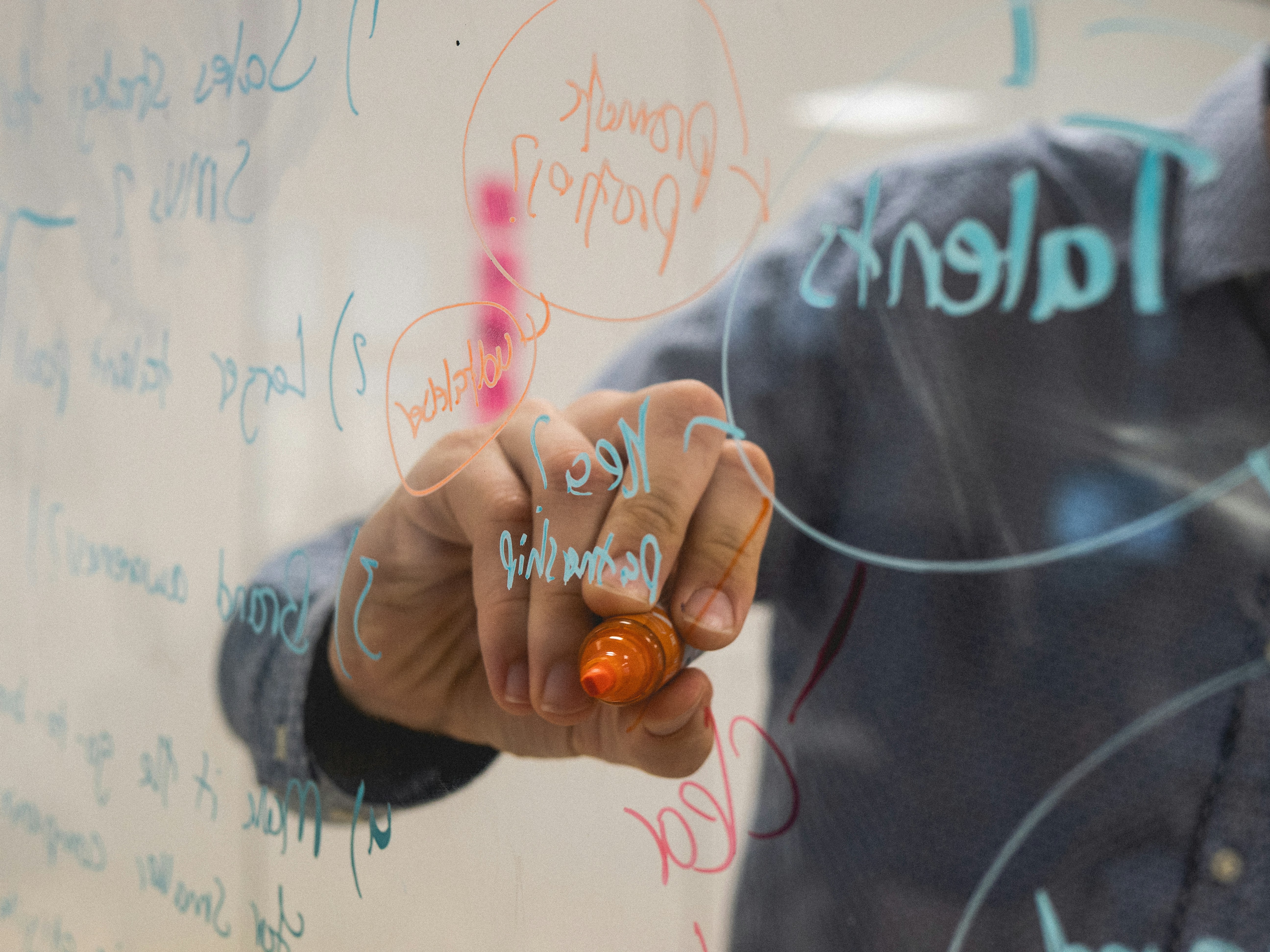
Sessions take place online via video call. Your tutor uses a shared digital whiteboard where both tutor and student can write, draw diagrams, and work through problems in real time — exactly as you would on paper, but on screen.
A typical 60-minute session might begin with a short review of the previous week's topic, move into new content or a gap identified in the study plan, work through several practice questions together, and finish with two or three exam-style questions for the student to attempt independently while the tutor observes and gives immediate feedback.
As the exam approaches, full past paper sections are used under timed conditions. Mark schemes are reviewed together so the student understands exactly how marks are awarded — and exactly how to write an answer that gets them.
“Our son came to us predicted a grade 4 in GCSE Maths at the start of Year 11. By March, after four months of weekly sessions focused on algebra and number, he sat his mock and came out with a grade 7. He started doing extra practice on his own — which is how you know the confidence has genuinely shifted.”
Common Questions
Frequently asked questions — GCSE Maths tutoring
Nexus Academy offers online GCSE Maths tutoring from £14 per hour. Sessions are one-to-one with a degree-educated Maths specialist, and include a personalised study plan and monthly progress reports. The average rate for independent private GCSE Maths tutors in the UK ranges from £25 to £45 per hour.
Most students working with a Nexus Academy GCSE Maths tutor see a meaningful grade improvement within two to three months of consistent weekly sessions. The exact timeline depends on the starting grade, the target grade, and the specific gaps identified in the diagnostic. During the free demo lesson, your tutor will give you a realistic assessment of what is achievable and in what timeframe.
Yes. Foundation tier covers grades 1 to 5, and the difference between a grade 3 and a grade 5 on Foundation is significant in terms of topic knowledge and exam technique. Many of our students are on Foundation tier, and targeted tutoring on the topics most weighted in Foundation papers makes a clear difference.
Nexus Academy covers AQA, Edexcel, and OCR for GCSE Maths — which between them account for the overwhelming majority of GCSE Maths entries in England. When you book, please confirm your child's exam board and we will match them with a tutor who specialises in that specification.
Yes. GCSE Maths consists of one non-calculator paper and two calculator papers. Our tutors address both — including the specific mental arithmetic and estimation skills needed for Paper 1, and the efficient calculator use and method presentation expected in Papers 2 and 3.
AQA (8300), Edexcel (1MA1), and OCR (J560) all assess the same mathematical content across three papers — one non-calculator and two calculator — but differ in question style. AQA uses accessible, context-heavy language and is the most widely sat board. Edexcel has a more structured, progressive question style with strong multi-step calculation demands. OCR uses wordier questions, 100-mark papers (rather than 80), and places more emphasis on mathematical reasoning. A grade 7 on any board represents the same standard. Nexus Academy confirms the exact board and specification code before any sessions begin.
No. A formula sheet is provided in GCSE Maths exams for 2026 and 2027 across all three main boards, but students still need to know which formula applies to a given problem, how to rearrange it, and how to substitute values correctly under timed pressure. Students who have to locate every formula on the sheet mid-calculation lose time and are more likely to apply formulae incorrectly. Nexus Academy teaches formulae to fluency and focuses heavily on application, rearrangement, and the problem-solving skills the formula sheet does not replace.
Foundation tier covers grades 1 to 5 and weights 50% of marks towards standard procedures. Higher tier covers grades 4 to 9 and requires 60% of marks through reasoning and problem-solving — a significantly higher cognitive demand. Students who are consistently achieving grade 5 or above in mocks should usually be on Higher tier, as Foundation caps at grade 5. Students who sit Higher and score below the grade 3 boundary receive a U rather than a grade 3. Nexus Academy tutors advise on tier appropriateness during the free diagnostic session.
Students working with a Nexus Academy GCSE Maths tutor typically see meaningful grade improvement within two to three months of consistent weekly sessions. Mock results are diagnostic tools — they show exactly which topics and question types cost the most marks. Nexus tutors use mock papers and past paper analysis to identify the specific patterns of mark loss for each student and address them directly, rather than working through the full specification from scratch.
Still have questions? We're happy to help.
Foundation or Higher? GCSE Maths tier parent guide →
November resit? GCSE Maths November resit plan →
Moving to A Level? See A Level Maths tutoring →
Free revision guide: How to improve your GCSE Maths grade →
Comparing quotes? How much does a GCSE tutor cost in the UK? →
Start Today
Book a free GCSE Maths demo lesson
Your tutor will identify exactly where the gaps are and build a plan to close them. No payment required.
Book a Free Demo LessonFrom £14/hr · No commitment · Free first session