Quick answer
GCSE Computer Science Paper 2 is the programming half of the grade. On OCR J277 it is a written algorithms paper that prints Exam Reference Language. On AQA 8525 the long programming sit is Paper 1 (two hours). On Pearson 1CP2 Paper 2 is on-screen Python. Nexus Academy drills the sitting your child actually takes, from £14/hr after a free demo — not a generic “learn to code” hour.
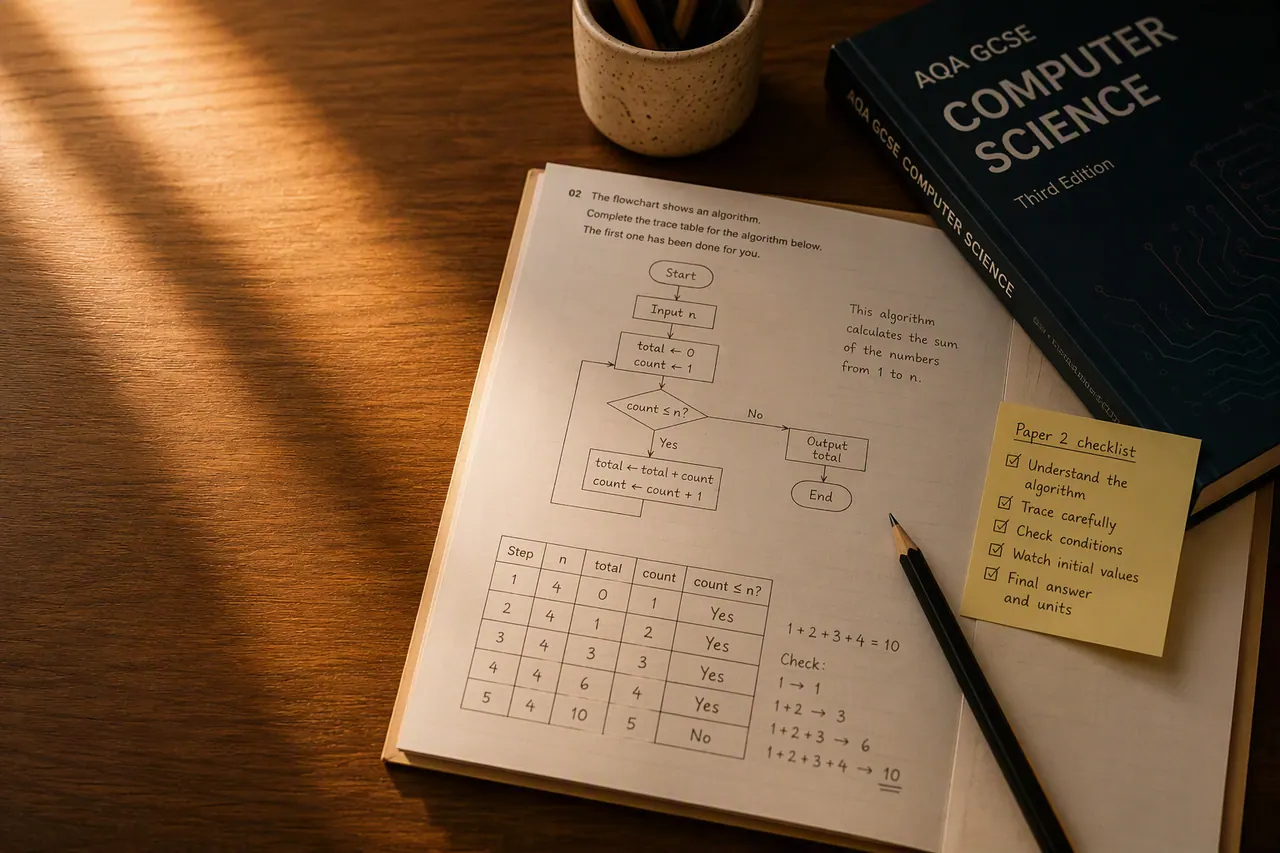
This is the paper that separates students who can copy a class demo from students who can read, dry-run and complete an algorithm under time. Parents searching “GCSE Computer Science Paper 2” are usually looking at a mock that fell apart in Section B — not at a child who “doesn’t get computers.”
Match the board first: OCR vs AQA vs Edexcel Computer Science. Put the weekly plan around the leak list in how to improve GCSE Computer Science. For tutoring, see GCSE Computer Science tutoring.
What each board actually sits
| Board | Paper | Shape |
|---|---|---|
| OCR J277 | J277/02 Algorithms and programming | 1h 30 · 80 marks · 50%. Section A concepts; Section B practical programming in a written paper. Code printed in Exam Reference Language. |
| AQA 8525 | Paper 1 Programming | 2 hours · 90 marks · 50%. Design, write, test, refine. Python 3 is usual; C# / VB.NET if the centre teaches them. |
| Pearson 1CP2 | Paper 2 Application of Computational Thinking | 2 hours · 75 marks · 50% · on-screen Python. Debugging and the exam IDE are part of the grade. |
Trace tables — where method marks sit
A dry run is not “I know what the code does.” Examiners award marks for completing the table: a column per identifier, a row per pass, the output the algorithm actually produces. Students who skip rows, mix comparison with assignment, or invent a final print lose the whole question.
Practise with a pencil on paper for OCR and AQA written papers. Pearson 1CP2 still needs the habit, then the same logic typed in the on-screen environment. Between lessons, one named trace beats a vague “do some coding.”
OCR Exam Reference Language is not optional
OCR J277 prints algorithms in its own Exam Reference Language. Students may answer in that language or in a high-level language they know, but they must be able to read ERL on the paper. A Python-only student meets unfamiliar notation in the hall and spends the first minutes decoding instead of scoring.
Nexus Academy always reads the stem in ERL first, then writes the answer in the language the question allows. That is exam technique, not a second programming course.
Test data and “complete the code”
Normal, boundary, erroneous. Name one of each and say what should happen. “It ran on my laptop” is not a test plan the scheme can tick.
Complete or correct an algorithm. Fill the missing construct; do not rewrite a different, easier program. Marks sit on the specified inputs, processes and outputs.
File handling and arrays. OCR Section A still examines these as concepts. Students who only write loops in class freeze when the paper asks for validation or a dry run of an array index.
Pearson on-screen vs OCR written — do not mix them
If the school entered 1CP2, two hours at a computer in Python is the exam. Indentation errors, runtime messages and the exam IDE are in play. Lined-paper Python is useful for thinking; it is not 1CP2 Paper 2.
If the school entered J277, there is no IDE in the hall. The shared editor in tutoring is a teaching tool so traces can be marked live — the assessment is still a written paper. AQA’s two-hour programming sit needs stamina drills, not only ten-minute snippets.
How Nexus Academy tutors Paper 2
A typical 60 minutes: a short trace or ERL starter, one past-paper extract from the paper that leaked, then five minutes naming the next task. Students leave with that named question, not “practise Python.” Parents can see what was set.
Nexus Academy is a tutoring company, not a marketplace. Free demo, then from £14/hr with no lock-in. Book via /book/ or GCSE Computer Science tutoring. Rates on Pricing.
Frequently asked questions
What is GCSE Computer Science Paper 2?
Nexus Academy treats Paper 2 as the algorithms and programming half of GCSE Computer Science — 50% on OCR J277 and Pearson 1CP2, and the two-hour programming paper on AQA 8525 (labelled Paper 1). The job is to design, write, trace and test programs the way that board prints them, not to “know Python” in the abstract.
How do I get better at OCR Exam Reference Language?
Nexus Academy always reads the OCR J277 algorithm in Exam Reference Language first, then writes the answer in ERL or Python as the question allows. Students who skip ERL misread assignment, selection and iteration. Weekly traces on past-paper extracts beat a Python crash course that never opens the paper.
Why do trace tables lose so many marks?
Nexus Academy marks trace tables as the examiner does: identifier columns, each iteration, the final output. Skipping a row, mixing = and ==, or inventing output loses the whole table. We complete dry runs on a shared editor until the habit holds under time.
Is Pearson Paper 2 the same as OCR Paper 2?
No. Nexus Academy treats Pearson 1CP2 Paper 2 as a two-hour on-screen Python exam, while OCR J277/02 is a written paper that prints Exam Reference Language. Practising the wrong sitting wastes the term. Confirm 1CP2 versus J277 in the free demo.