Quick answer
Improve GCSE Computer Science by locking the specification (OCR J277, AQA 8525 or Pearson 1CP2), then cycling past papers → mark schemes → the paper that is leaking — usually Paper 2 traces or Paper 1 definitions. There is no NEA. Nexus Academy runs that loop one-to-one from £14/hr after a free diagnostic.
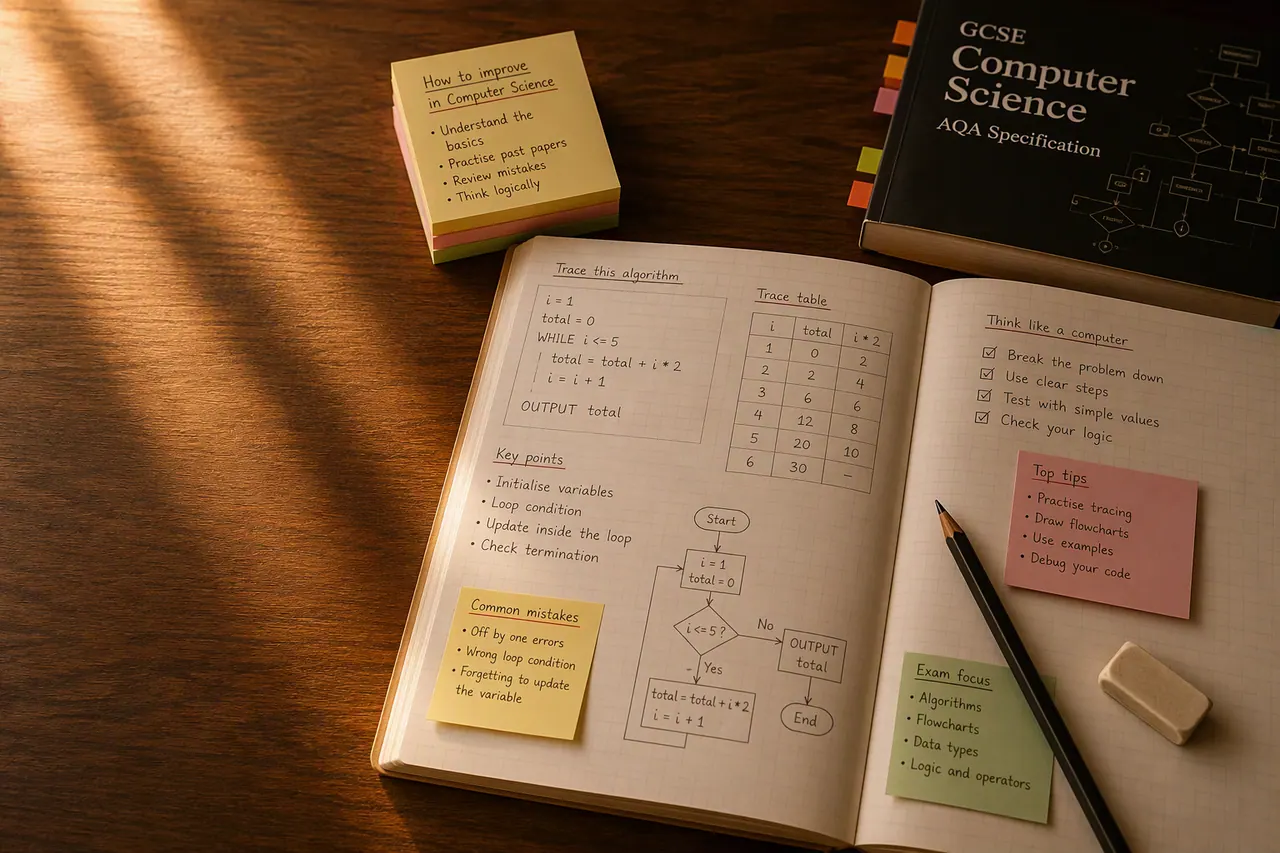
Computer Science grades improve when students stop treating the subject as “I can use Scratch” and start treating it as two exams glued together: systems theory you can revise from notes, and algorithms you can only mark by writing, tracing and refining code under time. Parents cannot usually mark Paper 2 at home. A trace table that is one column short still scores zero.
For the hire page, go to GCSE Computer Science tutoring. For which board you actually sit, use OCR vs AQA vs Edexcel Computer Science. For the paper that leaks most often, see GCSE Computer Science Paper 2.
1. Confirm the specification — then delete the other papers
Ask the teacher for J277, 8525 or 1CP2. Mixing boards trains the wrong Exam Reference Language, the wrong paper length, and — for Pearson — the wrong sitting (on-screen vs written). There is no Foundation/Higher split like GCSE Maths. One set of papers, grades 9 to 1.
| Check | Why it matters | Parent action |
|---|---|---|
| Board code | ERL vs Python vs on-screen IDE | Get J277 / 8525 / 1CP2 in writing |
| Which paper leaked | Systems definitions vs algorithms | Look at the last mock by paper, not overall % |
| Language | OCR must read ERL; Pearson must type Python | Do not switch language without the school |
| NEA myth | There is no coursework grade | Put that time into traces and past papers |
2. Sit a paper. Mark it. Name the leak.
Sit a recent paper — or timed sections if stamina is low. Mark against the official scheme, not a YouTube walkthrough. Write a short list: imprecise terms (encryption vs hashing, MAC vs IP), incomplete traces, skipped test data, or an eight-mark ethics answer that gives an opinion without the scenario.
That list is the weekly plan. Topic videos without a marked paper keep families busy without moving the grade. Command words still matter: state, explain, complete the table, write an algorithm. Dumping every fact about the CPU often misses the mark that only needed a named register.
3. Paper 2: traces, ERL, test data
Trace tables. Identifier columns, each iteration, the final output. Skipping a row loses the question — not one slip.
Exam Reference Language. OCR prints algorithms in ERL. Python-only readers misread assignment and selection before they write an answer.
Test data. Normal, boundary, erroneous. “It works on my laptop” is not a test plan the mark scheme can credit.
Worked detail is in the Paper 2 guide. Nexus Academy marks traces live on a shared editor — the feedback loop a mixed-ability class cannot run for every student.
4. Paper 1: precise words, shown working
“The CPU is the brain of the computer” scores nothing. ALU, CU, registers and the fetch–decode–execute cycle are the words the scheme lists. Binary and hex conversion need place-value working — a calculator-style answer with no columns drops method marks.
Logic gates and truth tables fail on mixed symbols and missing input combinations. Ethics and legal questions fail when the student gives a personal view instead of applying the scenario. A four-sentence plan before the long question is cheaper than rewriting it in the last five minutes.
5. When tutoring helps — and how Nexus Academy runs it
Tutoring helps when the leak list is stable: the same trace, the same ERL misread, or a non-specialist teacher covering Computing. It does not help if sessions become homework completion with no mark-scheme review. Computing teacher shortages make that pattern common — one-to-one supplies the missing live marking.
Nexus Academy is a tutoring company, not a marketplace. We start with a free demo: board, last mock, then a weekly plan from £14/hr with no lock-in. Book via /book/ or go to GCSE Computer Science tutoring. Compare hours, not only the sticker, on GCSE tutor cost in the UK and how lessons run on How It Works.
Frequently asked questions
How can I improve my GCSE Computer Science grade?
Nexus Academy improves GCSE Computer Science by confirming the specification code, then using marked past papers to find whether systems theory or Paper 2 algorithms is leaking — not by rereading notes. Weekly one-to-one sessions from £14/hr follow that list after a free demo.
Is GCSE Computer Science hard to improve in Year 11?
Nexus Academy typically sees mock-paper movement within two to three months of weekly sessions when the diagnostic has named a specific leak — usually trace tables, Exam Reference Language, or Paper 1 binary and logic. We do not promise a grade 9 from a 4 in six weeks.
Do I need to practise Python every day?
Nexus Academy sets one named task between lessons — a trace table, a past-paper question, or a short conversion drill — not a vague “practise Python.” OCR students must also read Exam Reference Language; Pearson 1CP2 students must practise on-screen. Daily unguided coding that ignores the paper shape rarely moves the grade.
When should we book a GCSE Computer Science tutor?
Nexus Academy recommends booking when the same Paper 2 question type fails on two mocks, or when a non-specialist teacher cannot mark traces live. Free diagnostic, then board-matched tutoring from £14/hr with no lock-in.