Quick answer
To improve a GCSE Maths grade, the most effective approach is to use past papers and official mark schemes to identify specific topics and question types causing mark loss, then address those gaps with focused topic practice before returning to timed paper conditions. One-to-one tutoring consistently accelerates this process, with most students seeing meaningful grade improvement within 8–12 weeks of targeted weekly sessions.
GCSE Maths is the qualification more parents and students ask about than any other. It is one of two subjects universities, colleges, and employers universally require a grade 4 pass in — which means the stakes are genuinely high. But it is also one of the most improvable subjects at GCSE level, because much of what costs students marks is not lack of mathematical ability — it is specific, addressable gaps in technique, topic knowledge, and exam approach.
This guide gives you the honest, practical answer to how GCSE Maths grades improve — based on what the research, the examiner reports, and the experience of tutoring students through this subject consistently show to work.
Know your specification before anything else
GCSE Maths is examined by three main boards in England — AQA (8300), Edexcel (1MA1), and OCR (J560). The mathematical content is almost identical across all three, but the question style and paper structure differ. AQA uses contextualised questions wrapped in real-world scenarios. Edexcel favours multi-step structured problems. OCR uses 100-mark papers (not 80) and emphasises mathematical reasoning.
Before revising anything, confirm your exam board and tier. Foundation tier covers grades 1–5. Higher tier covers grades 4–9. If your child is targeting grade 6 or above, they must be on Higher tier — Foundation caps at 5. For 2026 and 2027, a formula sheet is provided inside the exam paper for all three boards, covering complex formulae including the quadratic formula and volume of a sphere. This does not reduce the need to understand how to apply and rearrange these formulae — it only removes the memorisation requirement.
The right way to use past papers — most students do this wrong
Past papers are the single most effective revision tool for GCSE Maths — but only when used in a specific way. Completing a paper and putting it back on the shelf is wasted work. The value is in what happens after.
Complete a past paper under timed conditions. Mark it honestly using the official mark scheme — available free on your exam board's website. For every question where marks were lost, identify whether the error was: a topic gap (the student did not know the content), a method error (the student knew the content but made a calculation mistake), or a presentation error (the student did not show working, used wrong units, or misread the question instruction).
Address topic gaps with focused practice on that specific topic — not by doing another full paper. Return to timed paper conditions only after the gap has been addressed. Repeat the cycle. Students who follow this process consistently improve; students who simply accumulate completed papers without analysing them plateau.
Where to focus — the topics that consistently cause mark loss
AQA examiner reports identify the same topics as problematic series after series. For Higher tier students, the highest-value areas to address are:
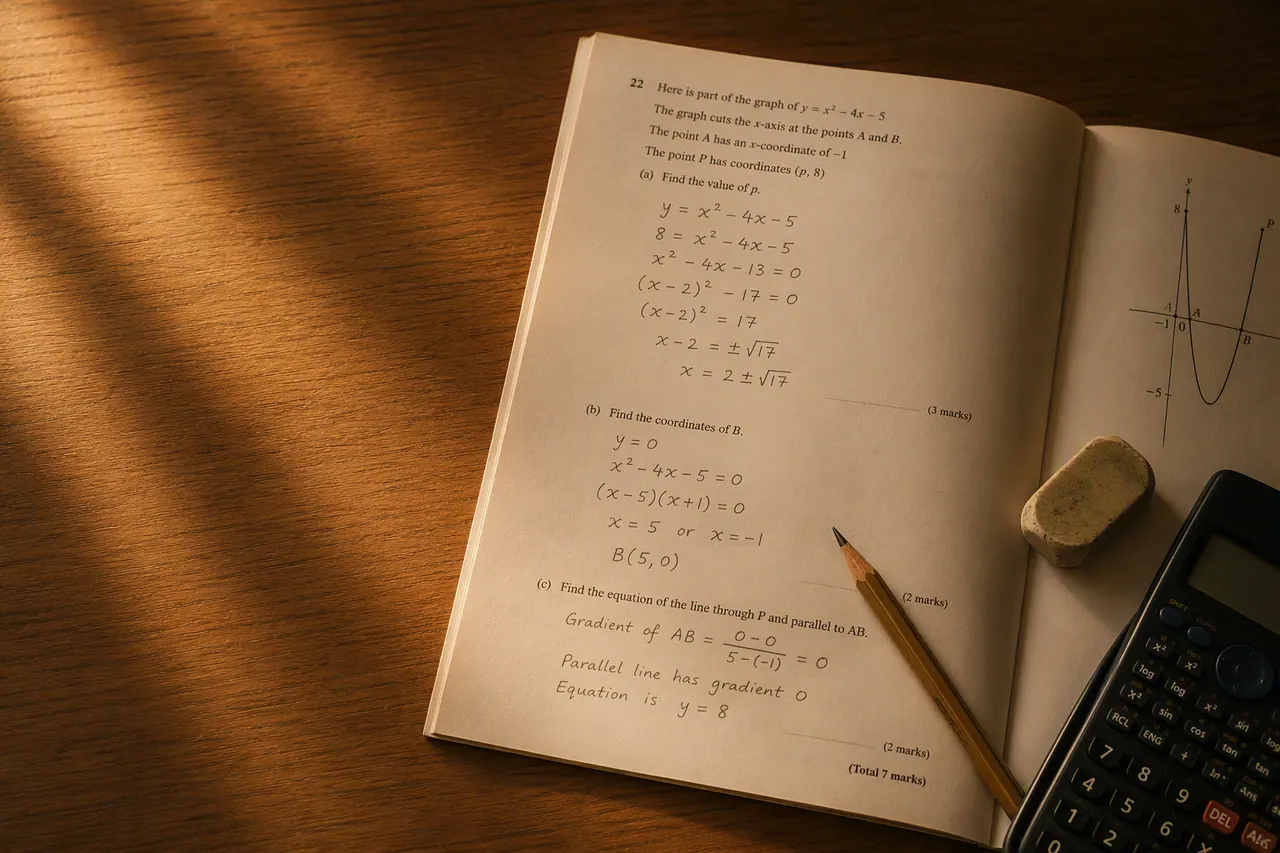
Algebra. Particularly quadratics, simultaneous equations, and algebraic proof. These topics appear in every Higher paper and carry significant marks.
Ratio, proportion, and rates of change. Consistently underperforming for Foundation and Higher students alike. Problems involving percentage change, direct and inverse proportion, and compound interest are straightforward with the right method but often rushed.
Geometry and measures. Particularly surface area and volume of composite shapes (AQA specifically identifies hemisphere-on-cylinder type questions as "poorly answered"), trigonometry applied to non-right-angled triangles, and circle theorems.
Statistics and probability. Cumulative frequency, box plots, and conditional probability (Venn diagrams, tree diagrams) carry consistent marks that students under-prepare for.
What examiners say separates grade 5 from grade 7
AQA and Edexcel examiners flag the same issues every year. The most impactful habits to develop:
Show every step of working on multi-mark questions. A correct answer with no working earns one mark where three were available.
Do not round intermediate answers. Round only at the final step, to the precision the question specifies. Premature rounding produces wrong final answers from correct working — one of the most avoidable sources of mark loss.
Read command words carefully. "Show that" requires all working. "Estimate" requires rounding before calculating. "Explain" requires a written sentence, not just a number.
Check your answer format. If a question asks for a fraction, a decimal answer earns zero even if numerically correct. Reread the final line of every question before writing your answer.
How one-to-one tutoring fits into this approach
Self-directed revision using past papers and mark schemes is effective — for students who can identify their own errors and address them independently. Many students cannot, and that is not a failure of effort — it is a failure of feedback. A student who consistently makes the same algebraic error will continue making it until someone explains specifically what is going wrong and why.
One-to-one GCSE Maths tutoring accelerates the improvement cycle because the tutor identifies the error pattern in real time, explains the underlying issue, and builds the right habit through targeted practice. Most students working with a qualified GCSE Maths tutor on a weekly basis see a grade improvement within two to three months.
At Nexus Academy, GCSE Maths tutoring starts from £14 per hour, with a free diagnostic session before any paid sessions begin. Home-educated students follow the same Maths tutors after the exam centre names the board — see how to homeschool GCSE in the UK. See GCSE Maths tutoring → · View pricing → · How it works → · Book a free session →
The honest guide to GCSE Maths improvement
The students who improve their GCSE Maths grade most significantly share four habits: they know their specification and tier, they use past papers with mark scheme analysis rather than just completing them, they address specific topic gaps rather than doing generic revision, and they get feedback on the specific errors causing mark loss — whether from a tutor or through rigorous self-marking.
GCSE Maths is not a fixed ability. It is a set of learnable skills and techniques. Most grade improvements from 4 to 6, or from 5 to 7, come from closing specific identifiable gaps — not from a general increase in mathematical ability. The gap is almost always smaller than it feels.