Quick answer
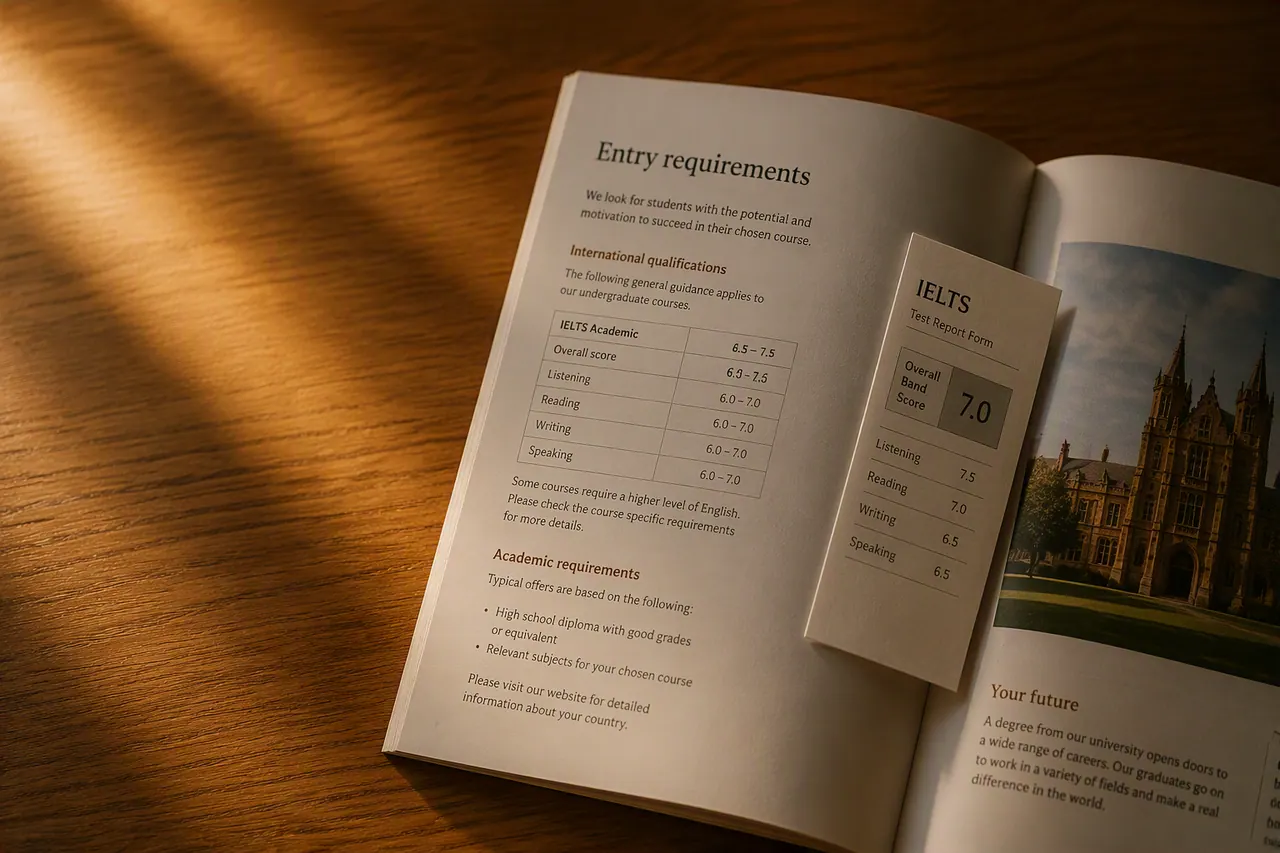
Most UK universities require a minimum IELTS Academic score of 6.0–6.5 for undergraduate entry and 6.5–7.0 for postgraduate entry. Russell Group universities typically require 6.5–7.0 for undergraduate and 7.0–7.5 for postgraduate. Oxford and Cambridge require IELTS 7.5 with no band below 7.0. Always check the specific requirement for your chosen course, as requirements vary by department and programme.
Getting into a UK university requires meeting both your academic grade requirements and your English language requirements. For international students, the IELTS Academic test is the most widely used way to demonstrate English proficiency to UK admissions offices. This guide gives you the current IELTS score requirements across different tiers of UK universities for 2026 — with the important caveat that requirements vary by university, course, and even department, and you should always verify the specific requirement for your target institution.
UK university IELTS requirements — 2026 reference guide
| Institution type | Typical UG minimum | Typical PG minimum | Notes |
|---|---|---|---|
| Oxford University | 7.5 overall, no band below 7.0 | 7.5 overall, no band below 7.0 | Some courses require 8.0+ |
| Cambridge University | 7.5 overall, no band below 7.0 | 7.5 overall, no band below 7.0 | Varies by faculty |
| LSE, Imperial College | 7.0 overall, no band below 6.5 | 7.0–7.5 overall | Specific courses may differ |
| Russell Group (general) | 6.5–7.0 overall | 7.0–7.5 overall | Check each institution |
| Top 20 non-Russell Group | 6.0–6.5 overall | 6.5–7.0 overall | |
| Most UK universities | 6.0 overall | 6.5 overall | |
| Foundation programmes | 5.0–5.5 overall | N/A | Language pathway routes |
Overall band vs individual skill bands — the distinction universities make
Most UK universities set both an overall IELTS band requirement and a minimum requirement for individual skills (Reading, Writing, Listening, Speaking). It is not sufficient to achieve the required overall band if one or more individual skills falls below the minimum.
For example, a student who achieves an IELTS overall band of 6.5 by scoring 7.0 in Reading, 7.0 in Listening, 6.5 in Speaking, and 5.5 in Writing may not meet the requirements of a university that specifies “6.5 overall with no band below 6.0” — because the Writing band of 5.5 falls below the minimum, regardless of the overall band.
Writing is consistently the skill where students achieve the lowest individual band score. For students whose Writing is significantly weaker than their other skills, targeted Writing preparation is essential — not just overall score improvement.
Higher requirements for competitive courses
Many competitive professional degree programmes set English language requirements above the general university minimum. Medical degree programmes at UK universities typically require IELTS 7.0 overall with no band below 7.0. Law programmes at top universities often require 7.0–7.5. Teaching programmes require a minimum of 7.0 in all four skills at many institutions.
If you are applying to a competitive professional programme, check the course-specific English language requirement on the university's admissions page — not just the general university requirement.
IELTS validity — two years from the test date
IELTS results are valid for two years from the test date. If you sit the exam more than two years before your intended university start date, you will need to resit. Plan your IELTS test date accordingly.
Getting the score your university requires
The gap between a student's current IELTS level and their target band is almost always closeable with focused, structured preparation. Students who prepare specifically for IELTS — rather than relying on general English ability — consistently achieve higher scores than those who sit without preparation.
Nexus Academy offers one-to-one IELTS preparation from £25 per hour, starting with a free diagnostic session that assesses your current band level and identifies the skills most in need of development. IELTS tutoring → · IELTS vs TOEFL → · Pricing → · Book a free IELTS diagnostic →