
IGCSE Economics
IGCSE Economics Tutor Online — Cambridge 0455 and Edexcel
Looking for an IGCSE Economics tutor online? Nexus Academy matches students with a UK-qualified Economics specialist for Cambridge IGCSE (0455) or Edexcel International — one-to-one from £14 per hour, with a free demo lesson and no lock-in.
From £14/hr · Cambridge & Edexcel International · Free first session
Quick answer
Nexus Academy offers an IGCSE Economics tutor online from £14 per hour for Cambridge 0455 and Edexcel International, with a free demo lesson and no lock-in.
UK Specialists for International Students
Expert IGCSE Economics tutoring online
Looking for an IGCSE Economics tutor online? Nexus Academy matches students with a UK-qualified Economics specialist for Cambridge IGCSE (0455) or Edexcel International — one-to-one from £14 per hour, with a free demo lesson and no lock-in.
Nexus Academy is a UK tutoring company, not a marketplace or platform. You are matched to one economist — one-to-one tuition, a personalised plan, and a free demo lesson. There is no tutor directory to browse.
Cambridge IGCSE Economics (0455) and Edexcel International mark diagrams and evaluation ruthlessly — unlabelled axes or one-sided arguments leave easy marks behind. We diagnose whether the cap is diagram fluency, Paper 2 data response, or evaluation, then practise that step until it holds in a mock.
Also available: GCSE Economics tutoring →
The Challenge
Why IGCSE Economics challenges students who work hard
The most common frustration among IGCSE Economics students is working hard and still not achieving the grades the effort deserves. This almost always reflects a specific gap between knowing the economics and applying it at the level the mark scheme requires.
Diagrams drawn from memory but incorrectly.
Supply and demand diagrams, production possibility curves, and other required diagrams carry marks — but only when correctly drawn and labelled. A diagram with unlabelled axes, an incorrectly positioned equilibrium, or a shift drawn in the wrong direction earns zero marks regardless of the written explanation around it.
Analysis without a mechanism.
Cambridge IGCSE Economics rewards chains of reasoning — explaining why a change in one variable leads to a specific effect in another, through an identifiable mechanism. Students who state effects without explaining the economic process behind them are consistently capped below the higher mark levels.
Evaluation that is one-sided.
Extended questions requiring assessment, discussion, or evaluation explicitly reward consideration of both sides of an argument. Students who argue only one perspective, or who list both perspectives without weighing them, cannot access the top evaluation marks.
Our Approach
How Nexus IGCSE Economics tutors work
The diagnostic session for IGCSE Economics specifically assesses three things: the student's content knowledge across both micro and macro, their diagram accuracy and fluency, and the quality of their analytical and evaluative writing. Each of these requires a different approach, and it is unusual for a student to have equal strength across all three.
Sessions then address the identified gaps in priority order. Diagram work is practised hands-on using the shared digital whiteboard — drawing, labelling, and explaining the economic story shown in each diagram. Analytical writing is developed through past paper practice with mark scheme review. Evaluation is taught as an explicit framework and practised on every extended response question until it becomes habitual.
94%
of Nexus Academy students hit their target grade or band score
Syllabus Coverage
Cambridge IGCSE Economics topics we cover
All content is aligned to the student's specific exam board — Cambridge IGCSE or Edexcel International GCSE — and their tier (Core or Extended).
The basic economic problem
- Scarcity, needs and wants, opportunity cost
- Factors of production
- Production possibility curves
- Economic systems: free market, planned, mixed
The allocation of resources
- Demand: determinants and shifts in demand curve
- Supply: determinants and shifts in supply curve
- Price determination and equilibrium
- Price changes and their effects
- Price elasticity of demand (PED) and price elasticity of supply (PES)
- Market failure: externalities, public goods, merit and demerit goods, information failure
- Government intervention: taxes, subsidies, price controls, regulation
Microeconomic decision makers
- Household decision-making
- Business objectives and production decisions
- Labour market: wage determination, trade unions
- Government intervention in markets
Government and the macroeconomy
- Macroeconomic aims: economic growth, low inflation, low unemployment, balance of payments equilibrium
- Fiscal policy: government spending and taxation
- Monetary policy: interest rates
- Supply-side policies
Economic development
- Indicators of living standards: GDP, HDI
- Poverty and inequality
- Population and economic development
- Employment, unemployment and economic growth
- International trade: advantages, protectionism
- Exchange rates and the balance of payments
- Globalisation
International Exam Board Specialists
Cambridge and Edexcel International GCSE Economics — what differs
Cambridge IGCSE and Edexcel International GCSE have different specifications and mark scheme conventions. Your tutor knows both.
Cambridge IGCSE Economics (0455 / 0987)
Cambridge IGCSE Economics (0455, examinations from 2026) is assessed through two compulsory papers. Paper 1 is a 45-minute multiple-choice paper worth 30 marks (30% of the grade) — all 30 questions must be answered. Paper 2 is a 2 hour 15 minute structured paper worth 90 marks (70%): Section A is one compulsory data response question (30 marks) using previously unseen source material; Section B requires students to answer three questions from a choice of four, each worth 20 marks with four part questions. Cambridge examiner reports highlight consistent mark loss through incorrect or unlabelled diagrams, imprecise definitions, and evaluation that states rather than weighs arguments. Students who fail to use source data in Section A consistently score below the highest mark levels.
Edexcel International GCSE Economics (4EC1)
Edexcel International GCSE Economics has a similar two-paper structure. Paper 1 is multiple choice; Paper 2 is structured data response. Edexcel's questions tend to be slightly more directly worded than Cambridge's and the chain-of-reasoning expectation is explicit in the mark scheme — students are expected to develop their analysis through cause and effect with each step explained. Nexus tutors are familiar with both the Cambridge and Edexcel International GCSE Economics specifications.
Cambridge IGCSE Economics 0455 — Paper 1 vs Paper 2 strategy
Paper 1 — Multiple Choice · 45 minutes · 30 marks · 30%
All 30 questions must be answered. This paper tests definition precision and quick diagram recognition — students who know concepts vaguely but cannot distinguish PED from PES, or who confuse market failure types, lose easy marks here. Nexus tutors use Paper 1 practice to map content gaps before extended work on Paper 2.
Paper 2 Section A — Compulsory data response · 30 marks
Section A uses previously unseen source material on a real economic situation. Questions require definitions with Cambridge-precise wording, correctly labelled diagrams, analysis chains (mechanism, not just outcome), and evaluation that weighs both sides using the source data. Students who ignore the source material cannot access the highest mark levels.
Paper 2 Section B — Structured choice · 3 of 4 questions · 20 marks each
Students answer three questions from a choice of four. Each question has four part questions and may include calculations and diagrams. Revision priority topics include supply and demand with PED/PES, market failure and government intervention, fiscal and monetary policy, and international trade with exchange rates.

Inside a Session
What a typical IGCSE Economics lesson looks like
IGCSE Economics sessions combine three elements: concept teaching, diagram practice, and past paper work with mark scheme review.
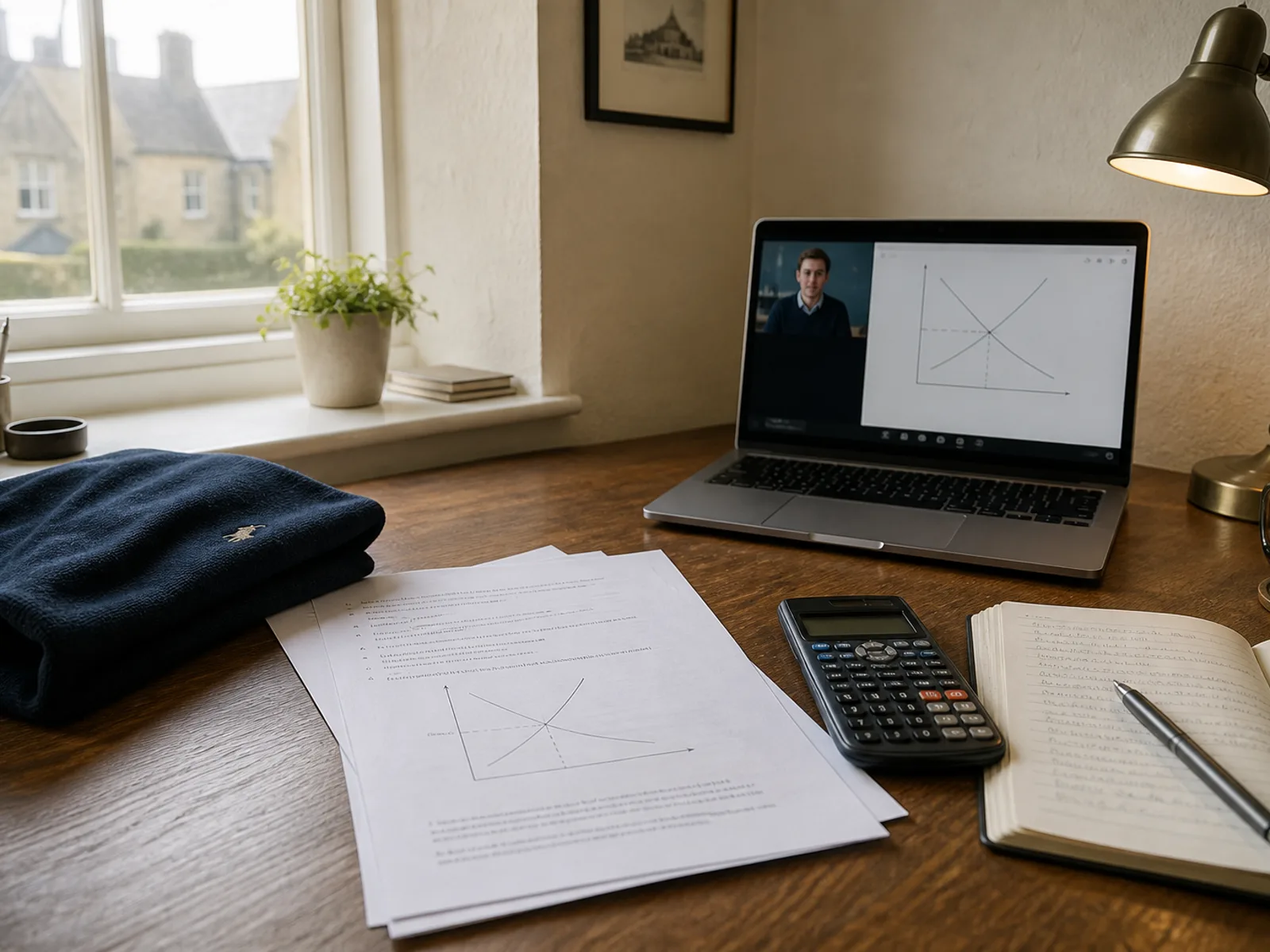
Diagram work is done on the shared digital whiteboard — your tutor draws and explains diagrams, then guides the student through drawing them independently with correct labelling and explanation. Getting diagrams right under exam conditions requires practice, not just understanding, and Nexus tutors treat diagram fluency as a skill to be built deliberately.
For extended evaluation questions — the highest-mark questions and the ones most students find hardest — the tutor teaches the evaluation framework: first argument with evidence, counter-argument with evidence, contextualised judgement. This is practised on every relevant past paper question until it becomes automatic.
“My son was taking Cambridge IGCSE Economics at his international school in the UAE. He found the diagrams particularly difficult — he kept drawing them incorrectly under pressure. His Nexus tutor spent four sessions specifically on diagram technique, going through each major diagram type until he could reproduce them correctly and explain them clearly. He went from a C to an A in his final exam.”
Common Questions
Frequently asked questions — IGCSE Economics tutoring
Nexus Academy offers an IGCSE Economics tutor online from £14 per hour for Cambridge IGCSE (0455) and Edexcel International. Sessions are one-to-one with a degree-educated economist, a personalised plan, and monthly progress reports. There is no lock-in — cancel anytime after the free demo lesson. That £14 figure is Nexus Academy's academic floor for IGCSE Economics, not a marketplace starting bid and not an agency rate of £50–70. You are matched to one economist rather than browsing tutor profiles. The free demo diagnoses the Paper 1 and Paper 2 route, and which diagram or evaluation step is costing marks, so paid sessions attack the leaks. Most families book a weekly 60-minute lesson through the exam year and add extra sessions before mocks. Compare that with typical UK academic tutoring around £35–45 per hour. Nexus Academy is a tutoring company: the price includes the lesson, the plan, and the reports, with no minimum block.
Nexus Academy is a UK tutoring company, not a marketplace or platform. We provide one-to-one IGCSE Economics tutors — and tuition — online from £14 per hour, matched to Cambridge 0455 or Edexcel International (4EC1). The free demo confirms the Paper 1 and Paper 2 route, and which diagram or evaluation step is costing marks, before any paid sessions. Parents searching "where can I find an IGCSE Economics tutor online" are usually comparing directories; Nexus Academy matches you to one economist instead. Sessions run on a shared digital whiteboard so supply-and-demand diagrams, data response, and evaluation can be marked live. Tuition can start in Year 10 or as a Year 11 mock-recovery block, including for British-curriculum schools outside the UK. Book from any timezone — there is no city page and no in-person office. After the demo you receive a short plan covering diagrams and the evaluation framework examiners reward. Cancel anytime. The same £14 rate is on the pricing page, identical to the IGCSE Economics hire FAQ.
Diagrams carry marks directly in Cambridge and Edexcel IGCSE Economics papers. Supply and demand diagrams, production possibility curves, and other required diagrams earn marks when correctly drawn, labelled, and explained. An incorrectly labelled diagram or one with a shift in the wrong direction earns zero, regardless of the written explanation around it. Cambridge examiner reports identify incorrect or missing diagrams as a consistent source of avoidable mark loss. Nexus Academy treats diagram fluency as a specific skill and practises it in every programme.
Cambridge IGCSE Economics (0455 / 0987) and Edexcel International GCSE Economics (4EC1) cover the same core microeconomic and macroeconomic content but differ in paper structure and mark scheme emphasis. Cambridge places strong emphasis on using source data in extended answers. Edexcel rewards chains of reasoning — cause, effect, significance — particularly in analysis questions. Both use a multiple-choice Paper 1 and a data response Paper 2. Nexus Academy tutors are familiar with both specifications.
Macroeconomics — government policy, economic growth, inflation, unemployment, exchange rates — is abstract because it deals with economy-wide effects that are hard to visualise directly. Nexus Academy tutors use specific real-world examples, case study material, and diagram-based explanations to make macroeconomic concepts concrete and applicable. The diagnostic session identifies which macroeconomic topics are causing the most difficulty and sessions are prioritised accordingly.
Yes. PED and PES calculations — using the formula, interpreting the result, and applying the concept to business and government policy questions — appear regularly in both Cambridge and Edexcel IGCSE Economics papers. Cambridge examiner reports specifically highlight PED as a topic where students frequently lose marks through calculation errors or incorrect interpretation. Nexus Academy covers PED and PES calculations as a standard part of every IGCSE Economics programme.
Evaluation marks in Cambridge and Edexcel IGCSE Economics are awarded for responses that consider more than one perspective, develop both arguments with reasoning and evidence, and reach a conclusion that is justified by the argument presented. Stating a conclusion without reasoning does not earn evaluation marks. Nexus Academy teaches a structured evaluation framework — argument, counter-argument, contextualised judgement — and practises it on every relevant question until it becomes automatic.
Cambridge IGCSE Economics (0455) uses a two-paper structure with heavy emphasis on diagram work and Paper 2 data response evaluation, and is graded A*–G. GCSE Economics (AQA 8136) uses extended 9-mark responses and UK-specific policy contexts, graded 9–1. Nexus Academy tutors confirm your child's specification during the diagnostic and prepare them for the correct paper formats and mark schemes.
Cambridge IGCSE Economics Paper 2 Section A is a compulsory 30-mark data response question using previously unseen source material — students must refer to the source data in their answers. Nexus Academy tutors practise source interpretation, diagram work, analysis chains, and evaluation specifically against Section A mark schemes, because this single question accounts for one third of the Paper 2 marks.
Still have questions? We're happy to help.
Studying UK GCSE? See GCSE Economics tutoring →
Choosing a board? Cambridge IGCSE vs Edexcel International GCSE →
Moving to sixth form? See A Level Economics tutoring →
Start Today
Book a free IGCSE Economics demo lesson
Your IGCSE Economics tutor will diagnose whether marks are leaking on diagrams, Paper 2 data response or evaluation — from £14/hr after the free demo. No payment required.
Book a Free Demo LessonFrom £14/hr · No commitment · Free first session
Prefer WhatsApp? Message us directly →