Quick answer
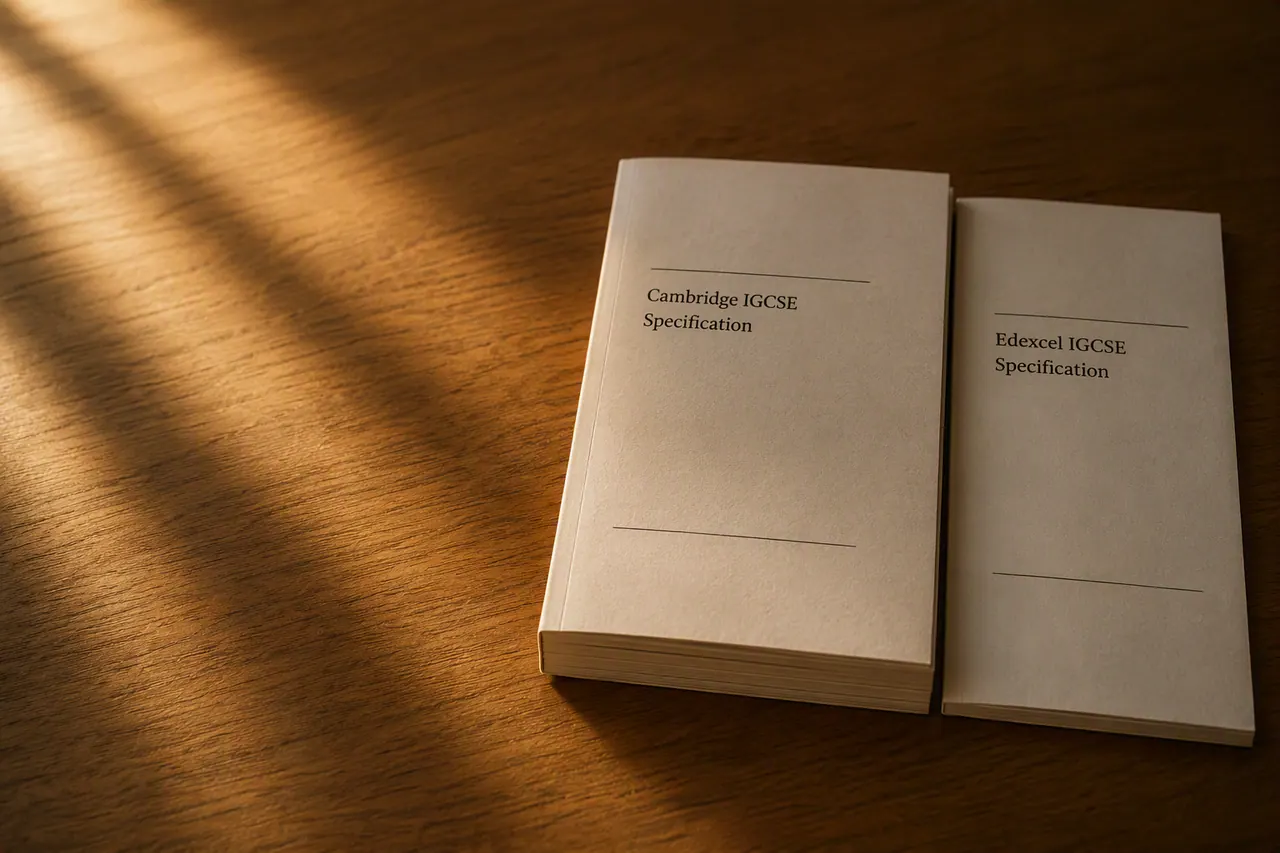
Cambridge IGCSE (offered by Cambridge Assessment International Education) uses an A* to G grading scale and is the world's most widely taken international qualification at secondary level. Edexcel International GCSE (offered by Pearson) uses the 9 to 1 grading scale aligned with UK GCSEs. Both are internationally recognised, accepted by universities worldwide, and studied at British curriculum international schools. The right choice depends on which qualification your child's school offers — students cannot typically choose between them independently.
If your child attends a British curriculum international school, there is a good chance they are studying either Cambridge IGCSE or Edexcel International GCSE — or both. These are the two most widely offered international versions of GCSE qualifications, studied at schools in over 140 countries worldwide. Parents frequently ask what the difference is, which is harder, and which universities prefer. This guide gives you a clear, current answer to all three.
Cambridge IGCSE and Edexcel International GCSE — the basics
Cambridge IGCSE is offered by Cambridge Assessment International Education (CAIE), part of the University of Cambridge. It is the world's most widely taken qualification at this secondary level, with students in more than 140 countries. Cambridge IGCSE has been available since 1988 and carries significant recognition among universities worldwide.
Edexcel International GCSE is offered by Pearson, the UK's largest examination board. Pearson also runs the standard GCSE qualifications used in England, and the International GCSE was designed to align with those qualifications for students at international schools. It is widely accepted by UK universities and is increasingly used at British curriculum schools outside the UK.
A* to G vs 9 to 1 — how they grade differently
| Cambridge IGCSE (A*–G) | Edexcel International GCSE (9–1) | Equivalent UK GCSE |
|---|---|---|
| A* | 9 | Grade 9 |
| A | 8–9 | Grade 8–9 |
| B | 7 | Grade 7 |
| C | 4–5 | Grade 4–5 (standard pass) |
| D | 3 | Grade 3 |
| E | 2 | Grade 2 |
| F–G | 1 | Grade 1 |
For university admissions purposes, both are recognised and both can be mapped to a comparable UK GCSE equivalent. A Cambridge IGCSE grade A* is broadly equivalent to a grade 9 on the Edexcel 9–1 scale; a Cambridge grade C is broadly equivalent to a grade 4–5.
Which subjects are available on each
Both Cambridge IGCSE and Edexcel International GCSE offer the core subjects: Mathematics, English Language, English Literature, Biology, Chemistry, Physics, Combined Science, Business Studies, Economics, and many more. The subject lists overlap significantly, though Cambridge offers a slightly broader range across some humanities and modern language subjects.
Both cover the same broad academic content in core subjects — the differences are in assessment style and paper structure, not in the content being taught. If you already know the subject, book a specialist rather than a generic IGCSE programme: IGCSE Maths tutor (Cambridge 0580 or Edexcel International), IGCSE Biology tutor (Cambridge 0610), or IGCSE Economics tutor (Cambridge 0455). The free demo confirms the live syllabus code before any paid sessions.
How the examinations differ
Cambridge IGCSE is assessed entirely through written examinations for most subjects — there is no coursework or controlled assessment in the majority of Cambridge IGCSE qualifications. The examination style tends to reward concise, precise written responses. Cambridge papers frequently use a tiered structure (Core and Extended) across several subjects including Mathematics, allowing students to target grades appropriate to their ability.
Edexcel International GCSE similarly uses written examinations as its primary assessment method. Edexcel's papers tend to be slightly more aligned with the question styles of the domestic UK GCSEs, which can make the resources and past papers more familiar to students and families who are used to the UK examination system.
Which do universities prefer?
For UK university admissions, both Cambridge IGCSE and Edexcel International GCSE are accepted on equal terms. Both are treated as equivalent to domestic UK GCSEs for the purpose of meeting subject-specific entry requirements.
For international universities — particularly in the US, Canada, Australia, and the Middle East — Cambridge IGCSE carries strong brand recognition as an internationally established qualification. Both are widely accepted, but Cambridge IGCSE's longer history and broader global presence means it tends to be more immediately recognisable to international admissions offices.
Neither is universally preferred over the other. The qualification your child's school offers is the one that matters.
The honest answer — it depends on the school
Students at international schools almost never choose between Cambridge IGCSE and Edexcel International GCSE — the school makes this choice. What matters is that your child is prepared specifically for the specification they are actually sitting, with the correct past papers, the correct mark schemes, and a tutor who knows the specific differences. Home-educated private candidates face the same constraint: the exam centre names the board. Compare the qualifications first in GCSE vs IGCSE for home education.
Nexus Academy tutors work with both Cambridge IGCSE and Edexcel International GCSE students across all core subjects. During the diagnostic session, we confirm the exact specification code your child is entered for and ensure all sessions are aligned to the correct materials. IGCSE Maths tutor online → · IGCSE Biology tutor online → · IGCSE Economics tutoring → · Explore IGCSE tutoring → · Pricing → · How it works → · Book a free diagnostic session →