GCSE Grade Boundaries Explained — How They Work and What They Mean for Your Child
Quick answer
GCSE grade boundaries are the minimum marks needed to achieve each grade (1–9) in a particular exam. They are set by exam boards after marking is complete, vary each year based on paper difficulty, and are released on GCSE results day in August. A grade 4 is a standard pass (broadly equivalent to the old grade C). A grade 5 is a strong pass. Grade boundaries for 2026 will be released on 20 August 2026.
Every GCSE results season, parents and students encounter the phrase “grade boundaries” — and every year, many of them are confused by what the phrase actually means, why boundaries vary between subjects and years, and what a particular mark actually translates to in terms of the grade their child receives. This guide explains everything clearly, with specific reference to the 2026 exam series.
The basic definition — and why they are not fixed
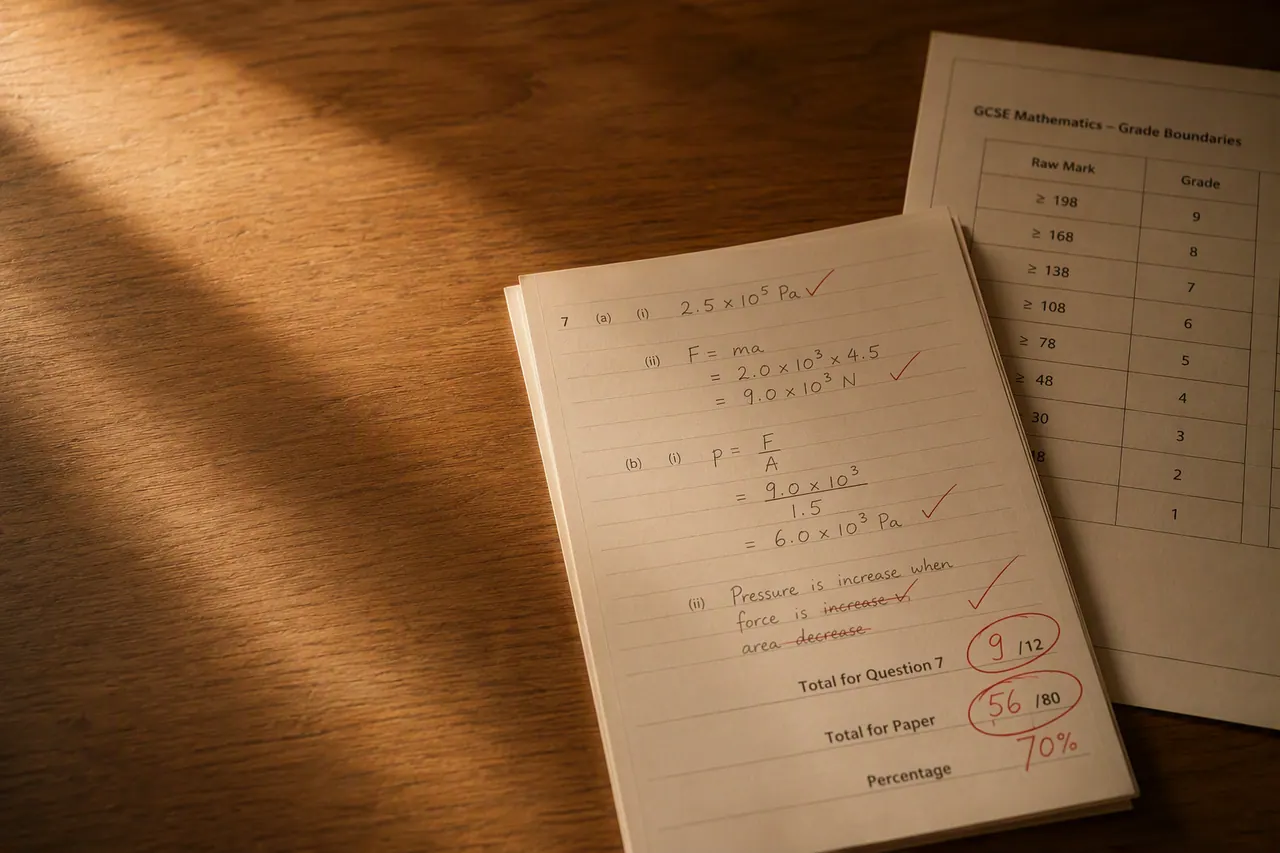
GCSE grade boundaries are the minimum raw marks a student needs to achieve each grade (1–9) in a specific exam paper. They are not fixed percentages — they are set after every exam series, based on the performance of that year's cohort and the difficulty of that year's papers.
The reason boundaries move is to ensure fairness. If a particular year's Biology paper is harder than usual, students will score lower raw marks for the same level of understanding they would have demonstrated in an easier year. The boundary for grade 7, for example, will be set lower to reflect this — so that a student who demonstrated grade 7 level work still receives a grade 7, regardless of the paper's difficulty.
This means that a student who scores, say, 150 marks out of 240 in GCSE Maths might receive a grade 7 in one year and a grade 6 in another year — not because their ability changed, but because the papers and cohort performance varied.
The awarding process — what happens after your exam is marked
Grade boundaries are not set arbitrarily. They go through a structured process called awarding:
Marking is completed. All exam scripts are marked by examiners. Statistical analysis of the cohort's performance is run.
Comparable outcomes analysis. Exam boards analyse the distribution of marks compared to previous years, adjusting for any known changes in cohort prior attainment. The goal is to ensure that the proportion of students achieving each grade remains comparable to historical series — so that a grade 7 in 2026 represents the same standard as a grade 7 in 2025 or 2024.
Senior examiner review. Senior examiners review scripts around the critical grade boundaries — particularly grade 4, grade 5, and grade 7 — and assess whether the quality of work at those mark thresholds genuinely represents the expected standard for each grade.
Ofqual oversight. Ofqual — the qualifications regulator — reviews the proposed boundaries for major subjects to ensure they are appropriate.
Release on results day. Grade boundaries are published on the same day students receive their results — never before. This prevents students from gaming the system by targeting a specific raw mark.
Understanding 9–1 grades and their equivalents
The 9–1 grading scale was introduced in England from 2017, replacing the A*–G system. All GCSE subjects have used the 9–1 scale since 2020.
Grade
Old equivalent
What it means
9
High A*
Top performing students — approximately top 3% nationally
8
Low A* / High A
Strong high achiever
7
A
Good pass at the higher level
6
High B
Above average
5
Low B / High C
Strong pass
4
Low C
Standard pass
3
D
Below standard pass
2
E
—
1
F/G
—
Grade 4 is the standard pass — broadly equivalent to the bottom of the old grade C. Universities, colleges, and employers generally require a grade 4 or above in GCSE Maths and English Language as a minimum.
Grade 5 is the strong pass — roughly equivalent to the top of the old grade C or low B. Some sixth form colleges and competitive post-16 programmes require a grade 5 in specific subjects.
Grade 9 was introduced specifically to distinguish the very highest achievers from the broader A* population under the old system. In 2025, approximately 3–4% of entries in most subjects received a grade 9.
Why grade boundaries look different for AQA, Edexcel, and OCR
Because each exam board writes its own papers, and those papers vary in difficulty, the raw marks required for each grade differ between boards and between years — even for the same subject.
For context, in the 2025 GCSE Maths series:
AQA required approximately 154–163 marks out of 240 for grade 7 on Higher tier (varying within that range based on the specific paper series)
Edexcel's boundaries for the same grade were different, reflecting differences in paper difficulty
OCR, whose Maths papers are marked out of 300 (not 240), uses a different mark scale entirely
These differences do not mean one board is harder or easier in terms of the grade you achieve — Ofqual's comparable outcomes process ensures that the proportion of students achieving grade 7 or above is similar across boards. The raw mark required simply reflects how difficult that board's particular papers were that year.
How Combined Science grading works — the double grade
Combined Science = a double grade
Combined Science (whether AQA Trilogy, AQA Synergy, Edexcel, or OCR) results in a double grade — two adjacent grade numbers reflecting the student's combined performance across Biology, Chemistry, and Physics. Examples: 9-9, 8-7, 6-6, 5-5, 4-3.
The two grades are always adjacent (they cannot differ by more than one grade). A student whose performance differs across the three sciences will receive a split grade such as 7-6 or 6-5, reflecting the average with a degree of spread. A student who scores very consistently across all three sciences will receive matching grades such as 7-7 or 6-6.
The lowest possible Combined Science grade is 1-1. The lowest grade a Higher tier Combined Science student can receive is 4-3 — a student who scores below the grade 3 boundary on Higher tier receives a U rather than a grade 3.
How to use grade boundaries productively — and how not to
Grade boundaries from previous years can help students calibrate how many marks they need to target, and what raw score they are likely to achieve on a mock paper. They should be used for context, not as a substitute for genuine learning.
The most productive use of boundaries in revision is this: after completing a past paper under timed conditions, look up the grade boundaries for that paper series and calculate which grade your mark would have earned. This tells you whether your current performance places you in your target grade range — or how far you have to go.
What grade boundaries cannot tell you is which specific questions or topics are costing you marks. That analysis requires working through the mark scheme question by question — which is the more important revision activity.
Grade boundaries for 2026 will be released on Thursday 20 August 2026 — the same day GCSE results are issued.
If your child is preparing for their GCSE exams and you want to understand exactly where marks are being lost — rather than just what grade they are currently on — Nexus Academy's free diagnostic session identifies the specific gaps and builds a plan to close them. Book a free session →